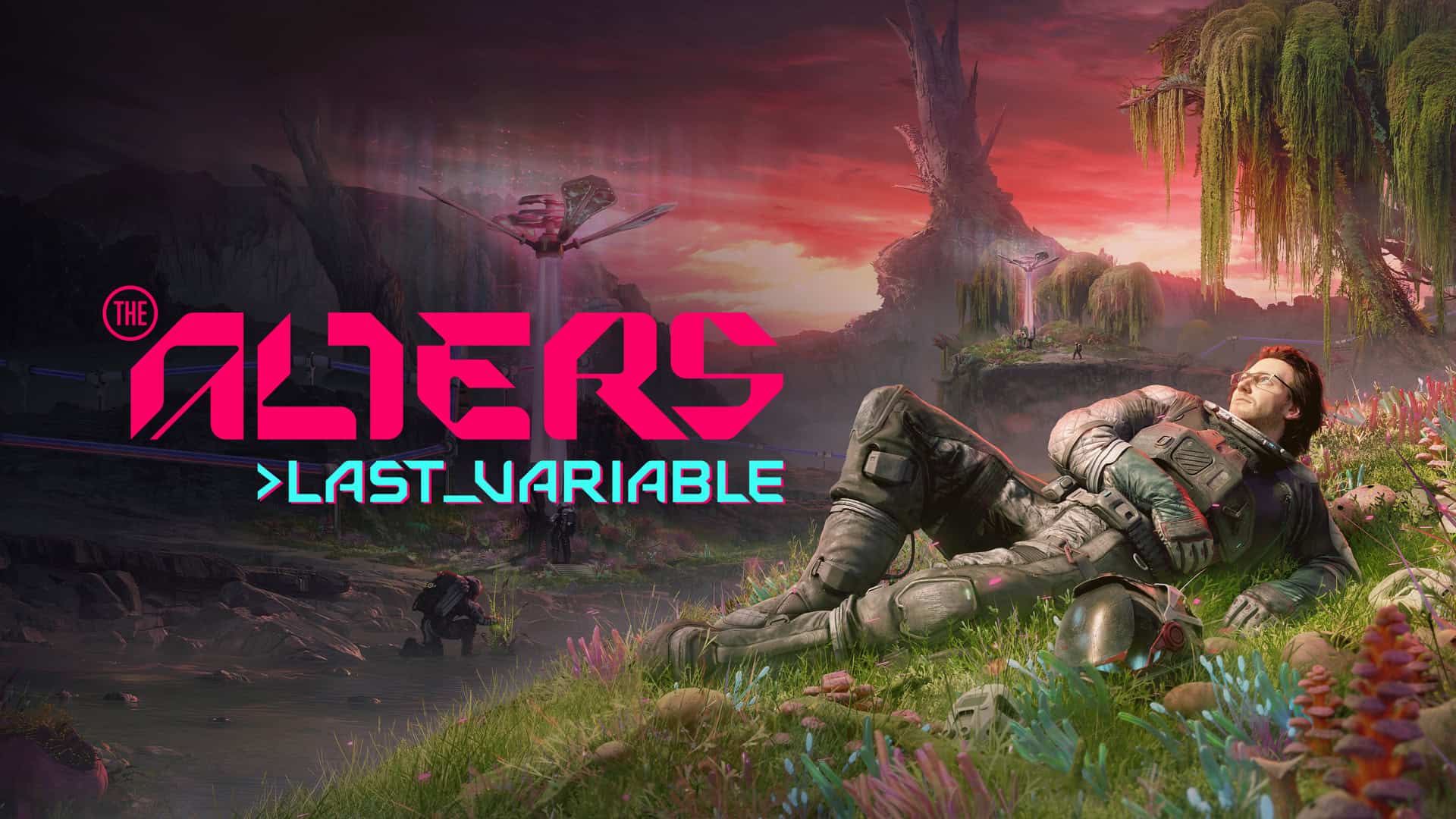
After finishing 11 Bit Studios’ sci-fi survival base-building adventure game, The Alters, there’s one thought that probably wasn’t on everyone’s mind: “Well, The Alters was a great game, but I sure wish it had more of The Scientist.” For the five people who did think that, you’re in luck!
The Alters is set in the future, where, due to food shortages, Earth is desperate to find a special mineral called Rapidium, which can be used for the rapid growth of organic material. Jan Dolski was among those who volunteered for a space expedition to search for Rapidium, but when the ship malfunctions and crashes on a desolate planet, his mission turns into a fight for his life as the sole survivor. On the upside, he does discover Rapidium on the planet. He must hold out long enough for the rescue team to arrive while also mining enough Rapidium to take home and save Earth from its hunger crisis. But there’s one problem: he can’t do it all by himself. Jan is forced to use the base’s Quantum Computer and Rapidium to not only clone himself but also change the life paths of his clones, so that their different choices in life result in new skills and professions. One of these Alters is The Scientist. Depending on our choices in the base game, The Scientist can discover an impossible oasis that not only sustains plant life but also somehow survives each sunrise while the rest of the planet is scorched. Unable to resist the temptation of curiosity, he can also choose to stay behind to study it.
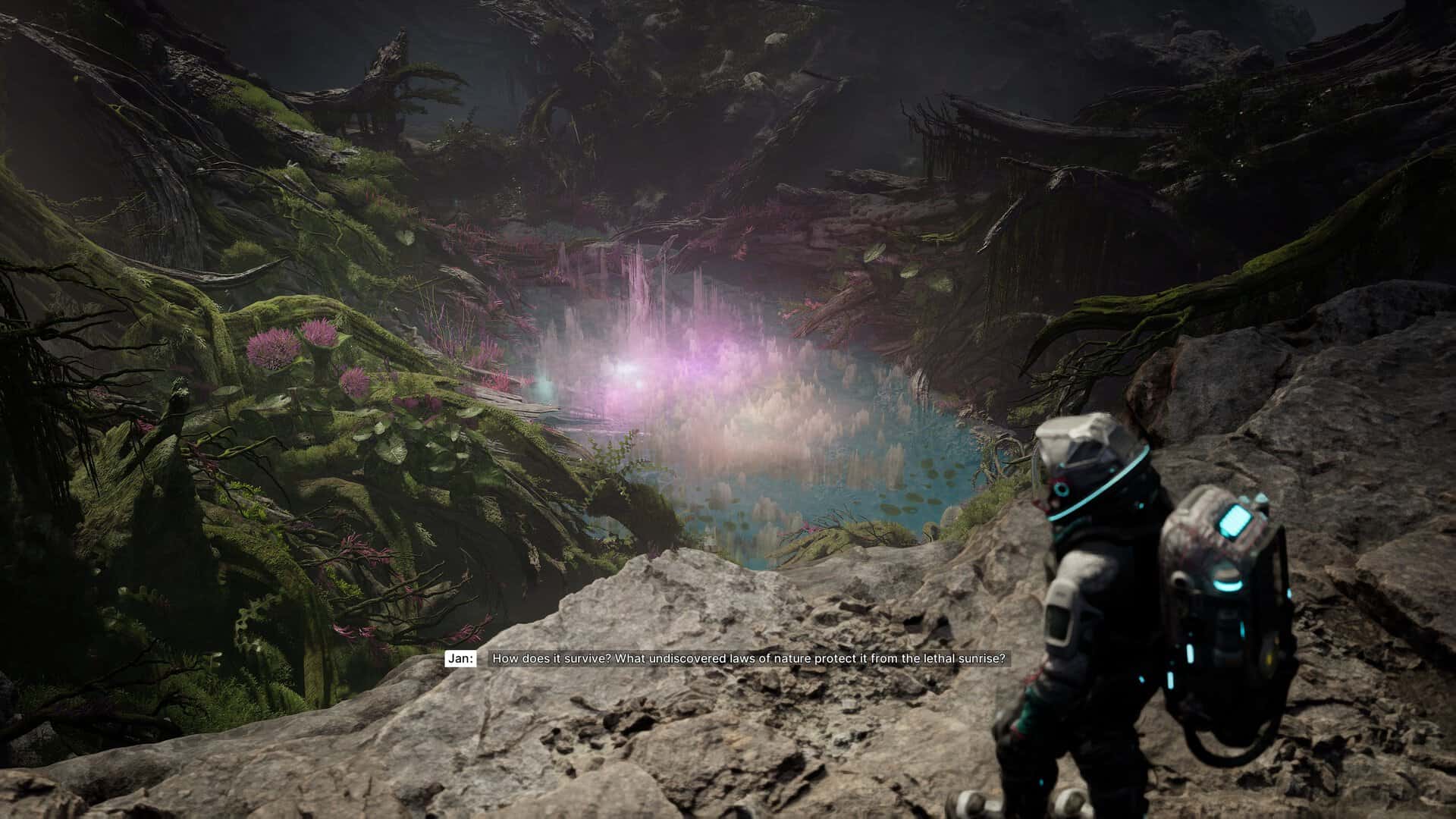
The Alters: Last Variable follows The Scientist on his mission to discover the oasis’ secrets and learn how it survives the planet’s deadly sunrise. However, the DLC begins not quite as expected; after a short intro cutscene where we see The Scientist carrying on his mission alone and setting up in the underground base created by the rebel Alters in the base game, we then suddenly cut to him waking up in The Womb, face to face with an older version of himself. With his last dying breath, the older Scientist tells this new clone that he must continue the mission and do a better job than he did. After the old man dies, we speak to JanBot, the AI created by our predecessor to help manage the project. JanBot fills us in and explains that the older scientist was unable to get very far in his research due to a lack of materials and equipment and needed to clone himself to carry on the mission. There is also one other major problem: in the base game, each time the sun rose, Jan would need to move the base to a new location to survive its deadly rays. It turns out that this period, during which the planet is completely uninhabitable, lasts for 13 years, with the sparse time that people can spend on its surface lasting only a few days. Because of this, The Scientist’s first task is to craft a cryosleep chamber so that he can sleep through the next 13 years. But… he can’t do it all by himself.
So, he decides to create new Alters, this time believing that if he simply creates Alters with a similar lifepath, just having delved into different fields of study, they’ll have the same mindset as his own, away from the common rabble, so that they can all work together in harmony with not a quibble over differences in sight – because that’s definitely how it will go, right?

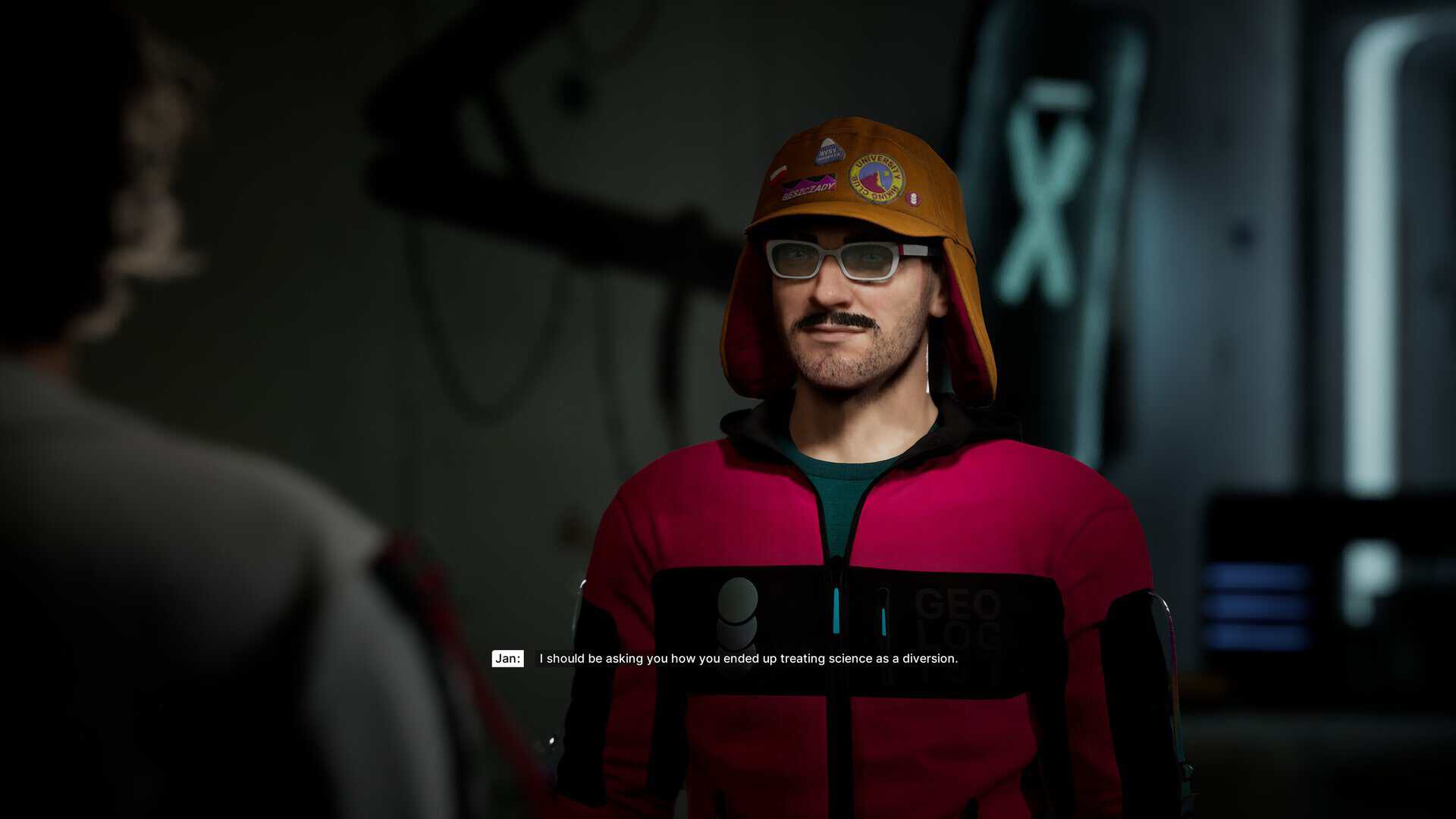
The original Jan faced plenty of criticism over his decision to not only clone himself to create a workforce to save his own skin and the corporation’s mission, but also to manipulate their memories and create people whose lives never existed. His Alters were not afraid to challenge him or question his leadership when he was doing a poor job, and also when he was doing a good job. And despite his high horse in the base game, The Scientist faces similar issues, as his idea of a scientist utopia filled with like-minded people doesn’t go to plan at all. His dreams are dampened when he realises that these four new Alters: The Biologist, The Physicist, The Chemist and The Geologist couldn’t be further away from his personality if he tried. After belittling the original Jan for not being able to keep his Alters in check, refusing to enforce constant crunch times, and for trying to make the base life easier with some non work-related pleasantries, The Scientist soon realises the heavy weight of leadership when each brainiac comes on board with their own personal problems, opinions and views on science – and yes, he does also build a social room.
Much of the mechanics in the base game remain, in fact, we pretty much pick up where we left off with most of the same equipment and resources available to us from the get-go. However, The Scientist has a different mission from the original Jan and a new environment to gather resources from. The Last Variable does more than expand on the story of the base game.
With the discovery of new plant life and minerals, The Scientist can analyse these in the Sample Analysis Module (SAM) to discover new upgrades and equipment, and also new substance mixtures which can be used for crafting and research. Similar to the base game, where much of the resource management consisted of building a network to connect mining outposts with the base, in The Last Variable, we can use our newfound knowledge to extract and process new substances, which we’ll need to set up a pipeline network to send back to the base. I organised this about as well as my PC’s cable management.
Part of The Scientist’s mission with the oasis revolves around terraforming uninhabitable sections of the planet so that the oasis can be expanded. Doing so unlocks new paths to new areas and mining outpost options, and also means that any equipment left in these areas during the sunrise won’t be destroyed – otherwise we would have to collect all of this and then set it back up again at the end of each cycle.
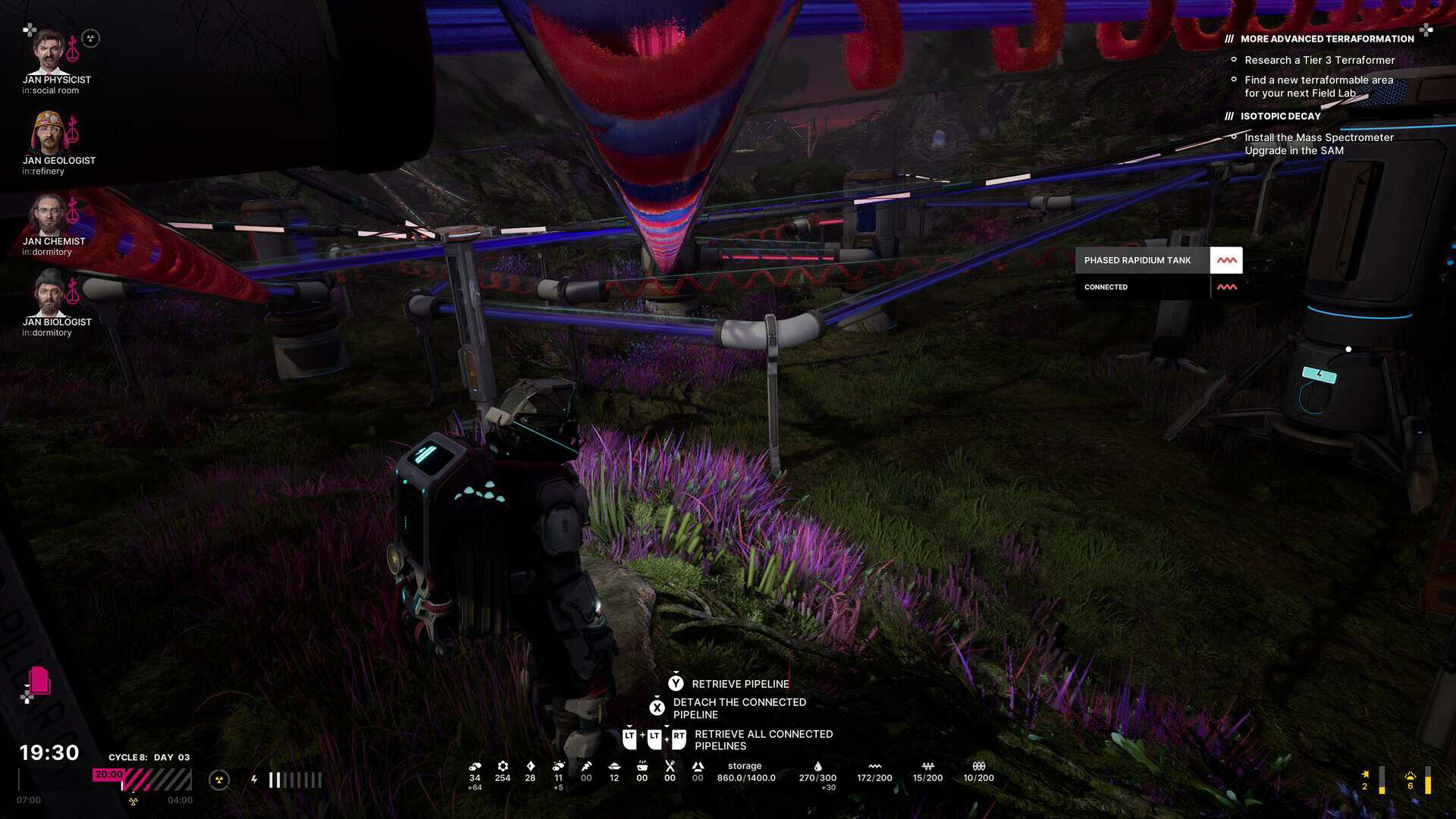
However, the more the planet is terraformed, the more planet activity increases, which means stronger magnetic storms, modules get damaged more often, and Alters will suffer more often from radiation within the base as a result. While this did mean that with each cryosleep, my Alters needed some time in the infirmary to recover from radiation burn, by this point in the game where I had terraformed much of the planet, I had a very robust resource mining system going on where running out of storage to store my resources was more of a problem than my Alters not being able to mine these resources for a couple of days. Which leads on to a major complaint I had with The Last Variable, where I felt that, with the simple change of the base now being stationary, much of the challenge was taken away from the management system.
At the end of each cycle, we need to have collected enough organics to put all of our Alters into cryosleep for the next 13 years. This figure is based on the number of Alters we have (four is the maximum), which opposes the base game, where the amount of resources required to move the base to the next location depended on how many modules we had added to expand our base. This put constant pressure on balancing out meeting our Alter’s needs and requests to improve their moods and avoid rebellion by adding various luxury modules, with the struggle of then needing to work harder to gather enough fuel to progress in the game – costing valuable time and effort, which also needed to go towards working on main quests. Without this sap on resources, base management suddenly became much easier, as there is no consequence to adding as many modules as we want, besides running out of space.
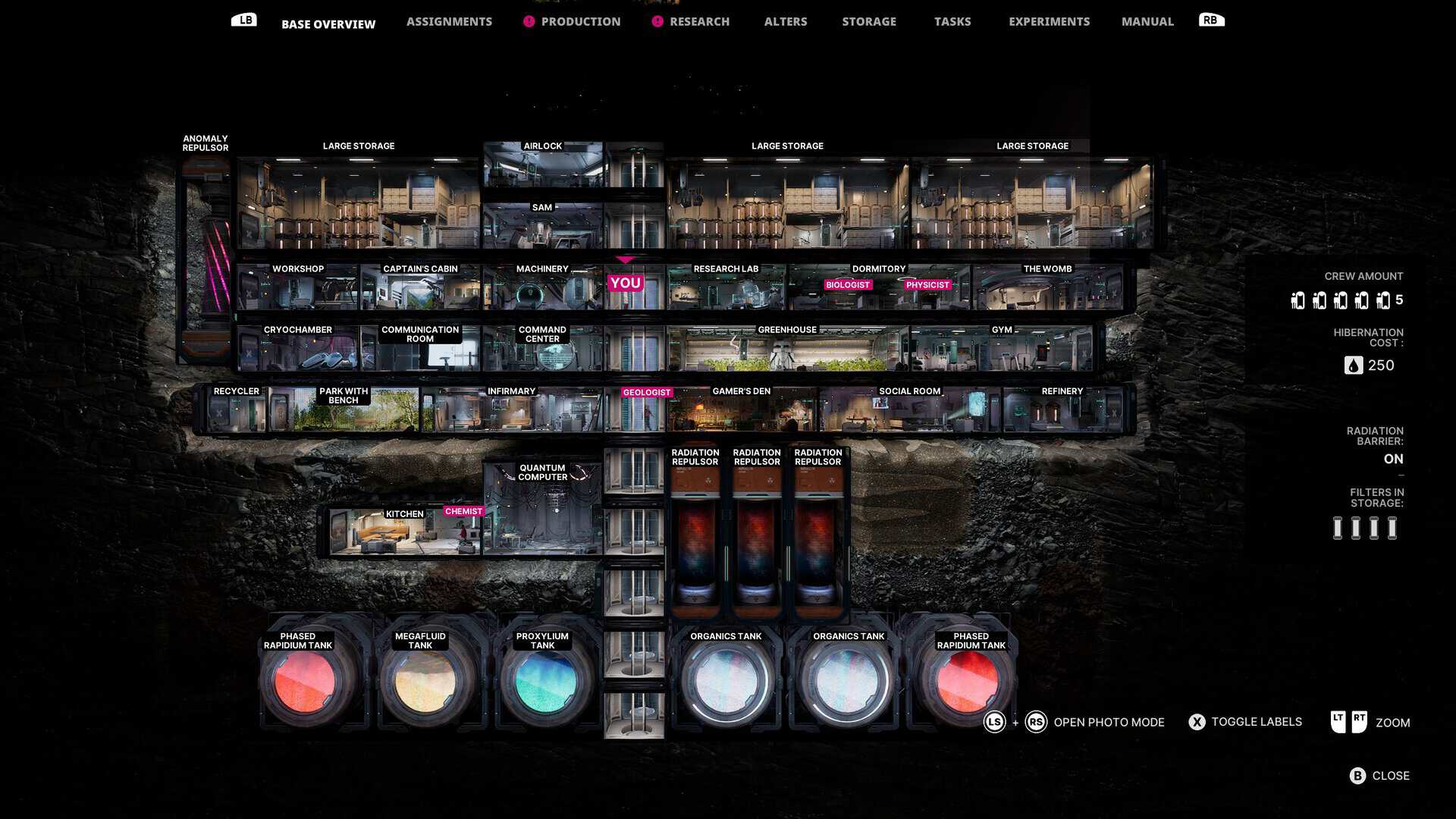
Even the simple removal of moving location once the sun rises takes away that anxiety of needing to pick up all of our equipment and having to spend the first day in the new location familiarising ourselves with its layout, finding the key mining outposts, and setting up that resource collection network again. Usually we’ll also come across a new anomaly that we’ll need to figure out how to approach. The Last Variable has no new anomalies.
In fact, I found that almost all of the changes to the management system in The Last Variable were responsible for the loss of the challenge that I enjoyed so much in the base game. The base game felt like a fight for perfection and really reflected the struggles of leadership in showing that you really can’t please everyone. In the base game, it felt like I never had enough hands to do everything that needed doing, even with a full group of Alters. In The Last Variable, I would happily leave two Alters in the infirmary to recover from radiation and would then forget they were there for a couple of days because I didn’t really need them.
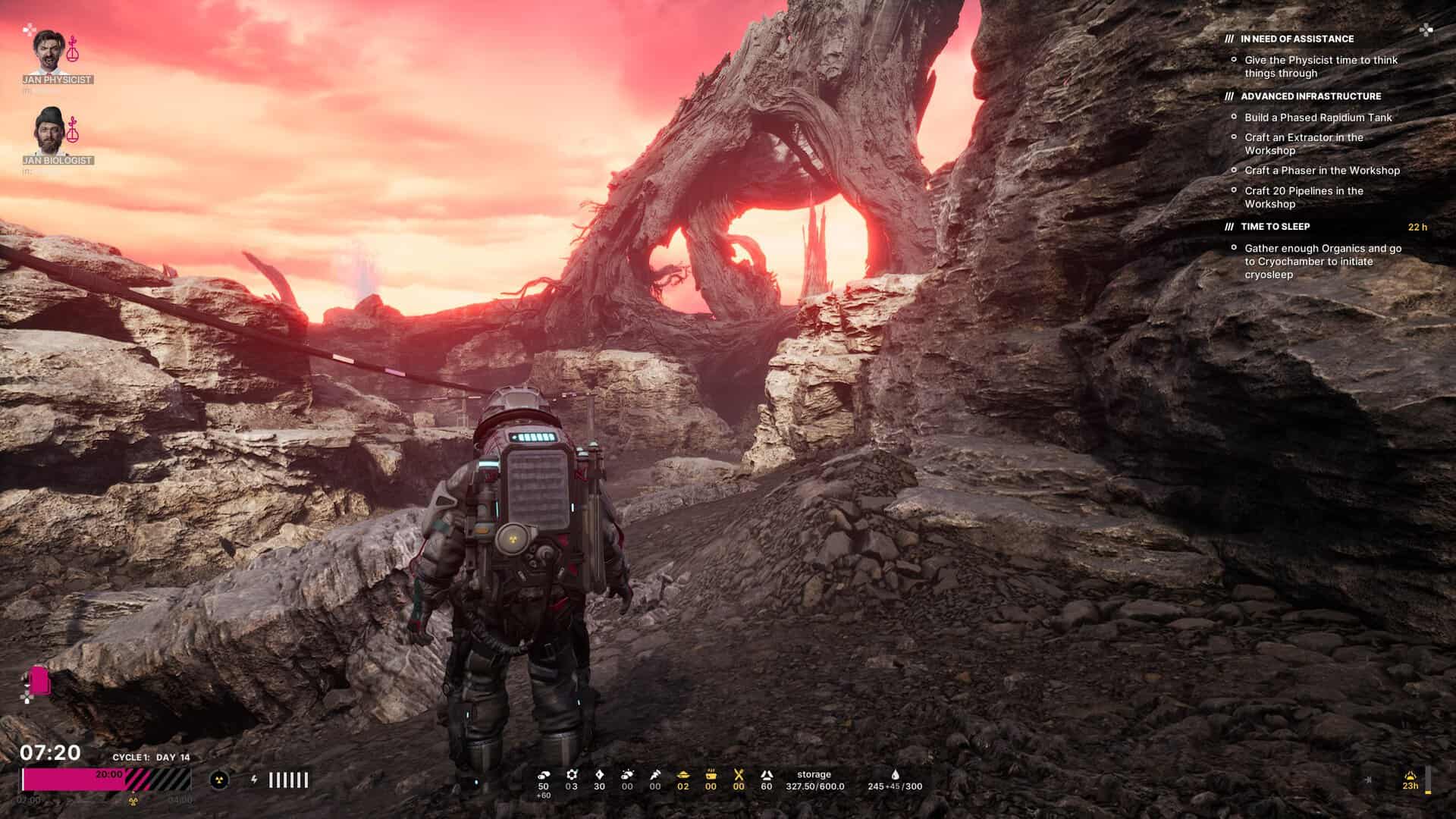
In the base game, there was always an intense, last-minute rush to gather enough resources to move onto the next location before the sun rose, while also juggling the individual needs and wants of my Alters and completing main quests in order to overcome whatever barrier was stopping us from moving. In comparison, going into cryosleep in The Last Variable can be done without having completed any main quests. In fact, you can wake up from cryosleep, and if you have enough organics, you can immediately go to sleep again for another 13 years with no consequence besides the wasted resources.
The lack of tension also extends to the story and The Scientist’s relationship with his Alters. Learning the science behind the planet was a strong aspect of the base game’s writing, and The Last Variable takes this further and adds so much more. However, some of the more chilling reveals in this story just aren’t delved into enough, such as the “siren effect” that the oasis has, the concept of spending decades isolated from Earth with no idea of how civilisation is progressing without you, and there are not even any new frightening anomalies to be discovered in an entirely new biome. The Scientist and his Alters are truly venturing into the unknown, but I just didn’t feel that anxiety – until right at the end, which is so worth sticking around for, by the way.
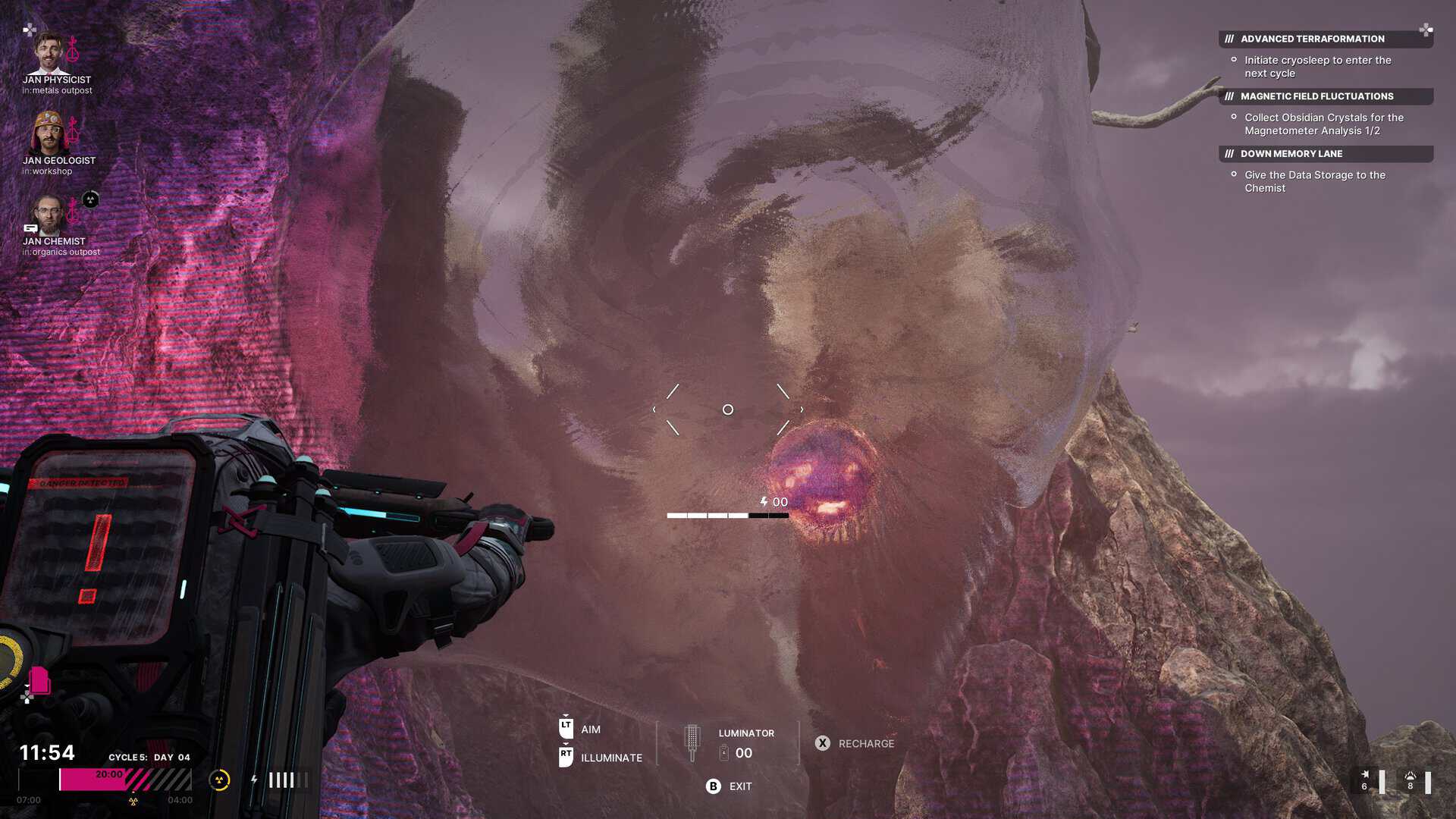
But as fascinating as it was to hear about the way the planet works and how this is built on with each discovery, a core part of the base game’s plot was Jan’s relationship with his Alters. Jan’s Alters all have their own great accomplishments, relationships, or events that shaped their personality. All of them have some form of trouble to overcome in order to face their new reality and be able to help Jan on his mission – as well as Jan himself, who also grows as a result of his Alters, literally opening up new dialogue options based on the lessons he has learnt.
In The Last Variable, each new Alter has their own struggles, which The Scientist can help them with. These are much shorter missions than those in the base game, which I was able to finish in the first few cycles. The base game distributed the Alter’s growth out across the game, whereas in The Last Variable this was done early on, and from that point onwards there was little to no bonding with the Alters. The Scientist doesn’t learn any new lessons from his Alters, which could also be down to his stubborn personality, but it is a shame not to see him have the growth that the original Jan did. We’re missing many of those touching moments, such as Jan creating a band with his Alters or having group discussions. In The Last Variable, all discussions are had one-to-one. We’re missing that found family feeling that the base game had, and I never felt this as strongly as at the moment when we find a video message left behind by the original crew. It was the biggest reminder of what The Last Variable was missing.
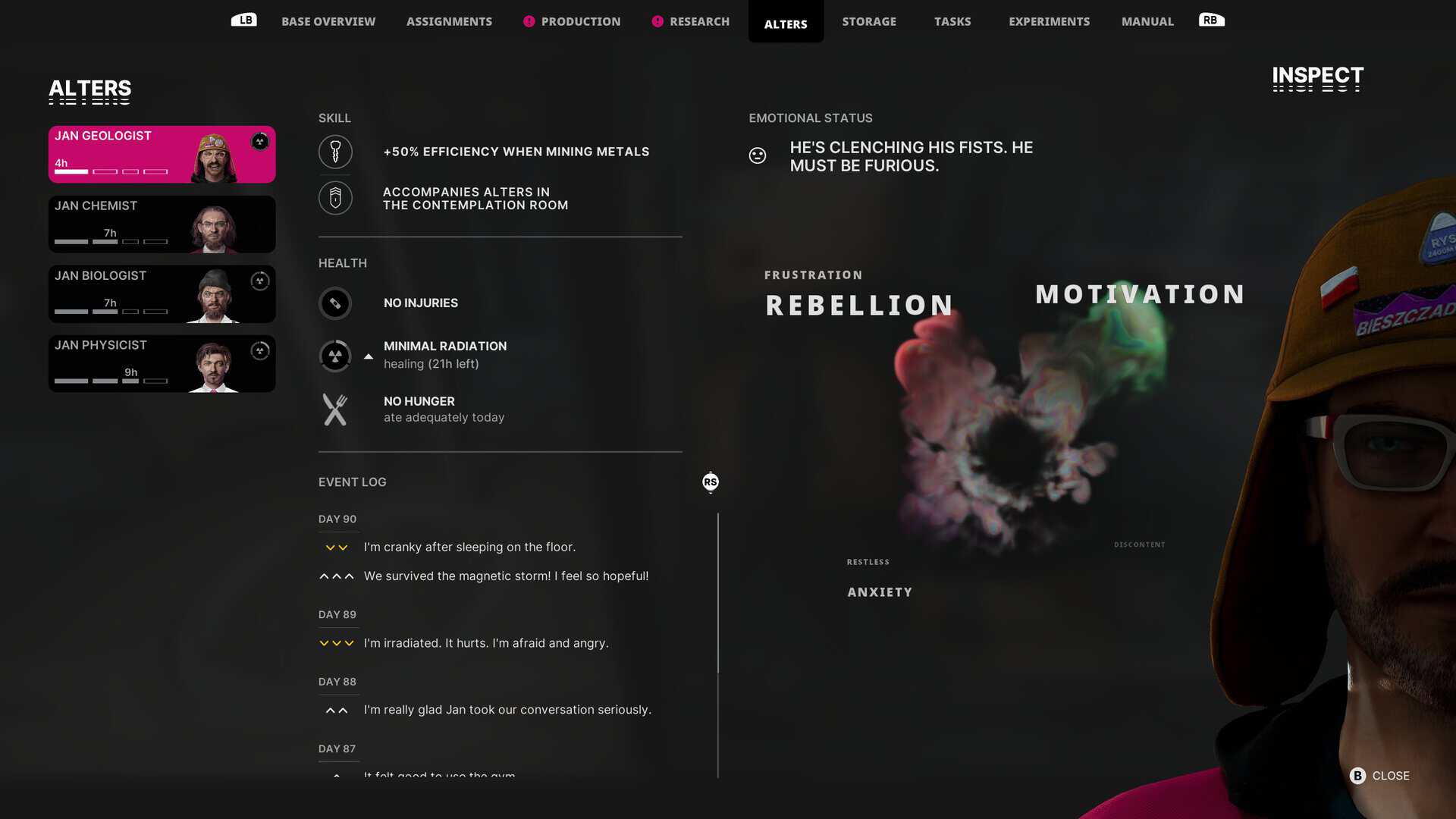
That being said, I loved the new Alters and their different personalities. The Physicist made me chuckle a few times with his repeated “pen through the folded paper” TED talk discussions, it was lovely to see The Chemist open up more and discover what he’s been missing by isolating himself sociallly, and while The Geologist doesn’t really change much from his hyper startings, I do feel like in this case it’s The Scientist who slowly learns to enjoy his spontaneous and dangerous experiments. Jan’s voice actor, Alex Jordan, also puts on another impressive performance of playing multiple versions of the same person – managing to somehow come up with another four voice variations for this character, along with unique mannerisms.
I enjoyed The Last Variable, there’s no doubt about it. Much like the base game, I swam through its twenty-hour playtime in just a few days, falling into an addictive state of fussing over its resource management and telling myself “just one more day” as I worked towards crafting specific equipment or getting into a good place for the next cycle. But despite being as long as the base game, it was definitely missing a large chunk of what made the base game so great. I do think this is further highlighted by its length; being as long as the base game meant I went in expecting an experience that was just as good. Had it been a shorter experience equivalent to what I would usually expect from a story add-on, it wouldn’t have felt like it was missing anything at all, as it does achieve its intention of solving the mystery behind the oasis and drawing a satisfying conclusion to The Scientist’s story.
Jess reviewed The Alters: Last Variable on PC with a provided review code. This review is based on the version of the game that was available at the time of writing, and our score will not be changed.
- Score
- 8/10 EXCELLENT - GAMEOBSERVER RECOMMENDS
- Summary
-
Jess says: The Last Variable is just as addicting as the base game of The Alters. However, being as long as the base game does put more light on its shortcomings. But as a DLC, it serves its purpose of expanding on the science behind The Alters' desolate planet and draws a conclusion to The Scientist's story.
- More
- GameObserver's Review Policy



 ObserverCrew Picks
 bserver
 bserver