To parents in the late 1990s, it probably felt like Pokémon was an infectious explosion that came out of nowhere. A genuine, literal mania that had overtaken not only their children, but their friends and neighbors’ children too. Kids from age three to 15, boys and girls, wealthy and poor, all coalesced into an obsession with a singular, homogeneous, electric-mouse-shaped force that gave birth to its own entire culture. The truth is, however, that Pokémon didn’t come from nowhere. Pokémon came from the dreams of a boy who loved collecting bugs. If you missed Part I of our series on the team of dreamers that created Pokémon, make sure to check it out before proceeding!
After finally releasing Pokémon in all major markets across the world in 1998, Nintendo had to make a decision. After all, based on the costs of developing the game over six years, plus the $13m they had already spent marketing the game in Japan, they were deep in the red. The time had come for Nintendo executives to make a decision – either cut their losses or double down on marketing and hope against hope this game had the juice. Hiroshi Yamauchi, then-President of Nintendo, laid down the law; Nintendo would spend $50 million ($100m today) just in North America advertising Pokémon in its release window. Remember, this was make-or-break not just for Game Freak, but for Nintendo as well. Pokémon Red and Blue were put in a very difficult position – they would need to be the most successful video games of all time, or else they would spell the end of Nintendo.

Upon release in North America, Pokémon Red and Blue became an instant hit. Together, the games instantly outsold Final Fantasy VII, which had previously been the year’s top title, in both Japan and the US. They’d become the fastest-selling Game Boy games as well, eight years into the handheld’s life, moving four million units in the US in just two months. As is well known, the Game Boy experienced rapidly declining sales in 1995-1996. The hardware was simply too old to keep up with current gaming trends and popular third-party titles. In fact, after selling just four million Game Boys in 1996, Nintendo saw an unprecedented hike in sales the following year, selling seven million units of an eight-year-old console. The Game Boy found new life, along with its successor, the Game Boy Color, bringing the hardware sales of the handheld to 118 million over its 11-year life span, singularly due to Pokémon.
It turned out that Satoshi Tajiri’s design philosophy had proven true. What people wanted was not high fidelity visuals and music in their games – all they wanted was to have fun. This philosophy would continue to guide Game Freak into both their best and worst years. It was in early 1998, as Pokémon finally made its worldwide debut, that Tajiri, seeing the success in Japan of the Pokémon Trading Card Game, toy lines, and anime that Nintendo had pushed, began to realize what he had created. He had, conservatively, created the new Star Wars. Pokémon was not a video game anymore. Nintendo’s aggressive marketing and multimedia approach had turned it into a way of life. Realizing he and his twenty-person team at Game Freak could no longer manage Pokémon as a franchise, Tajiri met with another key player in our story, Tsunekazu Ishihara.

Ishihara, a veteran developer of such games as Earthbound and Mario & Wario, had left his studio Ape Inc. in 1995 and jointly founded a new company called Creatures Inc. with the late Satoru Iwata, a now-revered game developer who will become very important to Pokémon’s story very soon. Creatures Inc. had been pulled in by Nintendo in 1996 to develop the Pokémon Trading Card Game and toy line, along with two spin-off games, Pokémon Stadium and Hey You! Pikachu, both for the Nintendo 64 console. Now very familiar with the Pokémon franchise (and more importantly, merchandising), Ishihara approached Game Freak and Nintendo about a complex solution to handle the exponentially growing franchise.
Ishihara saw the potential in Pokémon, but knew that they’d have to be even more aggressive with marketing and new products if they wanted this franchise to become the monolithic force he envisioned. He pitched an overzealous plan to pump hundreds of millions of dollars into creating new toy lines, merchandise from pencil cases to lunch boxes, extending the anime indefinitely, producing a theatrical movie every year, and tying everything into the new monsters that would appear in the sequel games, which were very early in development in 1998. For better or worse, if you want someone to point at as the reason Pikachu is the new face of capitalism, you can safely point at Tsunekazu Ishihara.

Ishihara proposed a new kind of holding company, called The Pokémon Center Co. (this would be renamed to The Pokemon Company less than a year later), to manage the Pokémon brand. Rather than owning an existing company, as most holding companies are created to do (think Alphabet with Google or Meta with Facebook), The Pokémon Company itself would be jointly owned by Game Freak, Nintendo, and Creatures Inc., each with an equal 33.3% share. The Pokémon Company would then be given full ownership of the Pokémon IP and the ultimate decision on everything from game development cycles to new movies to trading card MSRP.
Tajiri, as President and owner of the private company Game Freak, would continue to control one-third of the Intellectual Property and reap one-third of the benefits while being allowed to just focus on making video games. Nintendo would continue funding marketing, events, and movies, while Creatures Inc. would provide support on developing the upcoming new Pokémon games and lead development on merchandise, toys, and the Trading Card Game. Ishihara himself would head The Pokémon Company, with reps from Nintendo, Game Freak, and Creatures Inc. on the board of directors in equal numbers. All parties found this pitch amenable, and one of the strangest business structures in history was born.

If you ask any millennial about their primary exposure to Pokémon, they will likely first recall the TV series that began airing in the West in 1998. The anime, connected only loosely to the story of Pokémon Red and Blue, starred a 10-year-old boy named Ash Ketchum and his trusty sidekick Pikachu. Accompanied by the spunky water-type Pokémon trainer Misty and the lovelorn rock-type Pokémon trainer Brock, they traveled the world to become the very best (like no one ever was), meeting all kinds of people and Pokémon along the way. Each episode took Ash and friends to a new town where they would meet and learn about new Pokémon, and then be ambushed by the ridiculous and incompetent villains, Team Rocket. Jessie, James, and their talking Meowth were just as much main characters as our heroes, and despite their attempts to capture Pikachu every episode, their plans were always foiled. It was very formulaic, but that formula proved to be addictive to children in every country on Earth.
Dubbed and released by 4Kidz Entertainment in English, it proved to be the perfect recipe for a successful children’s show: A protagonist who starts as a loser who gets better each episode, who wins respectfully and loses gracefully, who is fueled by insatiable curiosity; a female character who didn’t take crap from anyone and had her own goals and agency; an older kid who could cook and clean, freeing the kids in the show from the need for a parent figure; and most importantly a new adorable monster with a new power each week that Ash could team up with to fend off incompetent comic relief bad guys. This perfect stew of ideas resonated with children in a way that had never been seen before. In fact, it was the most-watched children’s show in the world, and in 1999, Nielsen announced that over half of all boys age 6-11 in North America were watching it every week. It would hold that spot as the world’s #1 children’s show until 2003, after which it remained present near the top of the charts.

Ishihara’s visions of a future where Pikachu ruled the world with an iron tail proved to be reality. In preparation for its launch beyond English-speaking countries in early 1999, the newly formed Pokémon Company had created full dubs of the show’s first season in French, European Spanish, Italian, German, and Portuguese. They began airing the anime in late 1998 in Australia and all over Europe, dubbed for those audiences in their respective languages, where the show became a mega-hit by its own merit. By the time the first games were available to buy in Europe and Australia in early 1999, PokéMania had already overcome these territories. Ishihara’s big ideas about global expansion pushed Pokémon’s popularity far beyond the Anglosphere – millions of copies each of Pokémon Red and Blue sold in France, Spain, Germany, Portugal, and more in a matter of months.
Pokémon Yellow released worldwide in 1999 as a definitive edition, bringing in elements from the anime, such as Team Rocket’s Jessie and James, as well as having a Pikachu partner following you throughout the whole game. Together, Pokémon Red, Blue, and Yellow would go on to become the second best-selling games of all time with 46 million units worldwide by 2000, sitting only behind the giant that was Tetris. Accompanied by the most-watched children’s show in the world (viewed 3.1 million kids each week) and a trading card game that generated billions of dollars across the globe in 1999, it is hard to believe anyone truly escaped PokeMania. Ishihara, meanwhile, was finally ready to enter a new industry – Hollywood.

Back in 1996, The Pokemon Company had tapped veteran anime movie director Kunihiko Yuyama to serve as a general director of the Pokémon anime series. Based on that success, they selected him to direct their first theatrical movie, titled in Japan Pocket Monsters The Movie: Mewtwo Strikes Back. Yuyama pulled in Takeshi Shudo, who was one of the writers for the anime series, to pen the screenplay. One of the more notable things about Pokémon: The First Movie, as it was released in the West, is how incredibly different the original was to the English dub.
The original film for Japanese audiences featured a ten-minute prologue following a baby Mewtwo showing his backstory, explaining why he hated humans and his motivations for trying to create an army of clones. It was a heartfelt and touching segment that added context to the film, earning it generally positive review scores from Japanese critics. This movie was a massive hit in Japan, resonating with children and adults alike with its pondering existential questions about the meaning of life. Enter American producer Norman J. Grossfield.

Grossfield felt strongly that American audiences did not want sympathetic villains, and so removed the entire prologue to make Mewtwo seem like a maniacal villain with no redeeming qualities. Additionally, the English script removed all references to existentialism, focusing instead on race equality metaphors that were nonexistent in the Japanese script. In addition to changing signs and background words into English, Warner Brothers altered the backgrounds of towns and landscapes to look less Japanese and more like they took place in America. Grossfield also felt the musical score was not exciting enough for American audiences, and so pulled in John Loeffler and Ryan Shuckett, who had produced the iconic English Pokémon theme song, to write a new one. The Japanese producers strongly opposed all these changes, but The Pokémon Company had given full control over to Grossfield, and their cries were unheard.
In November 1999, Pokémon : The First Movie released into Western theaters to a box office of 172 million dollars off a budget of just five million dollars, selling an additional 10 million VHS units for home media the following year in the US. In fact, the day that Pokémon : The First Movie released into theaters, so many children stayed home from school to see it that teachers across the US dubbed it “a bad case of Pokeflu.” The critical response, however, was dire. Due to Grossfield’s rewrites, critics panned the film for having an incoherent message and effectively being a sound and light show to sell toys to children. With only a 16% score on review aggregator Rotten Tomatoes, it was widely lambasted while being compared to recent critically acclaimed anime films like Akira and Princess Mononoke, as well as Disney’s recent outings like Mulan and Tarzan.

At the end of the day, it didn’t matter; this critic-proof movie became the first anime film to top the North American box office, and remained as the sole title holder until 2021’s Demon Slayer. It truly was an event film like none before for young millennials. Pokémon : The First Movie remains the highest-grossing anime film in the US to this day. It was followed up with theatrical films Pokémon 2000: The Power of One and Pokémon 3: The Movie – Spell of the Unown, both of which were also huge box office successes, albeit with diminishing returns.
After that, the Pokémon films would continue to be released in theaters in Japan, but Miramax had bought the rights overseas and moved the series direct-to-video beginning with the fourth film, Pokémon 4Ever. Even as a direct-to-video film, Pokémon 4Ever was extremely profitable; Miramax would hold onto the Pokémon film rights until 2005, when they sold them to Viz Video. All told, 22 feature-length Pokémon films have been released to date.

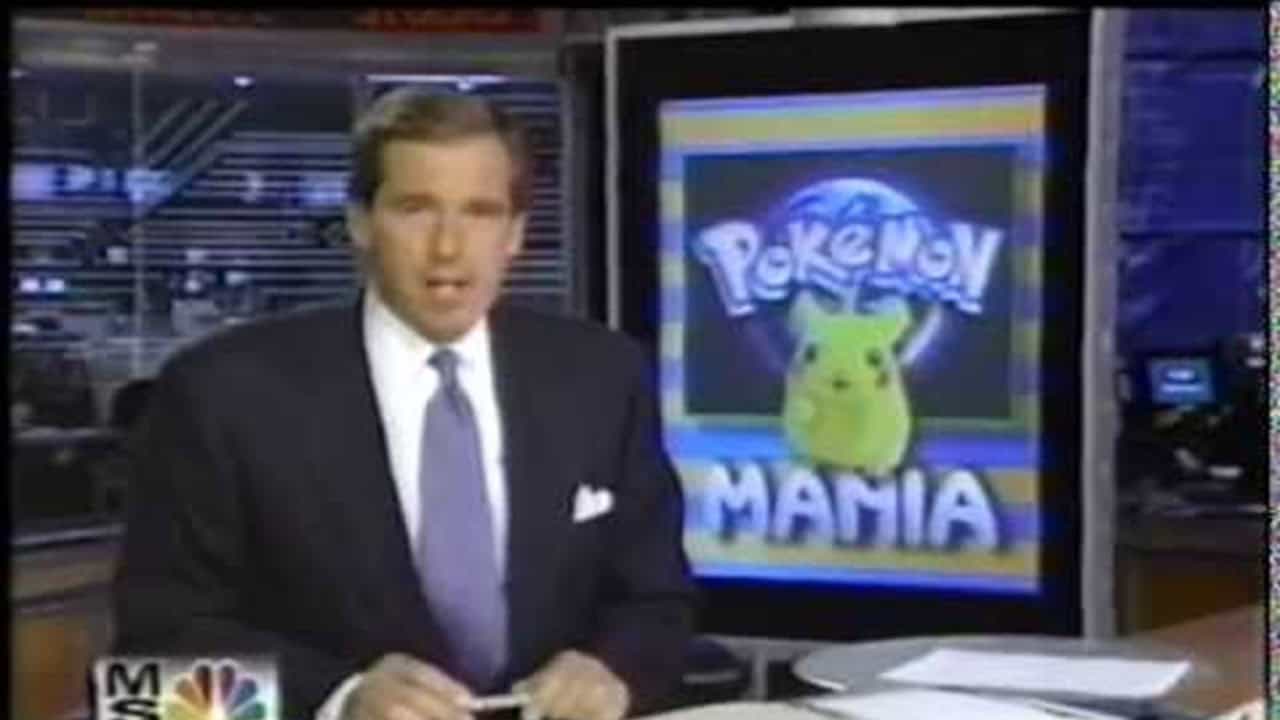
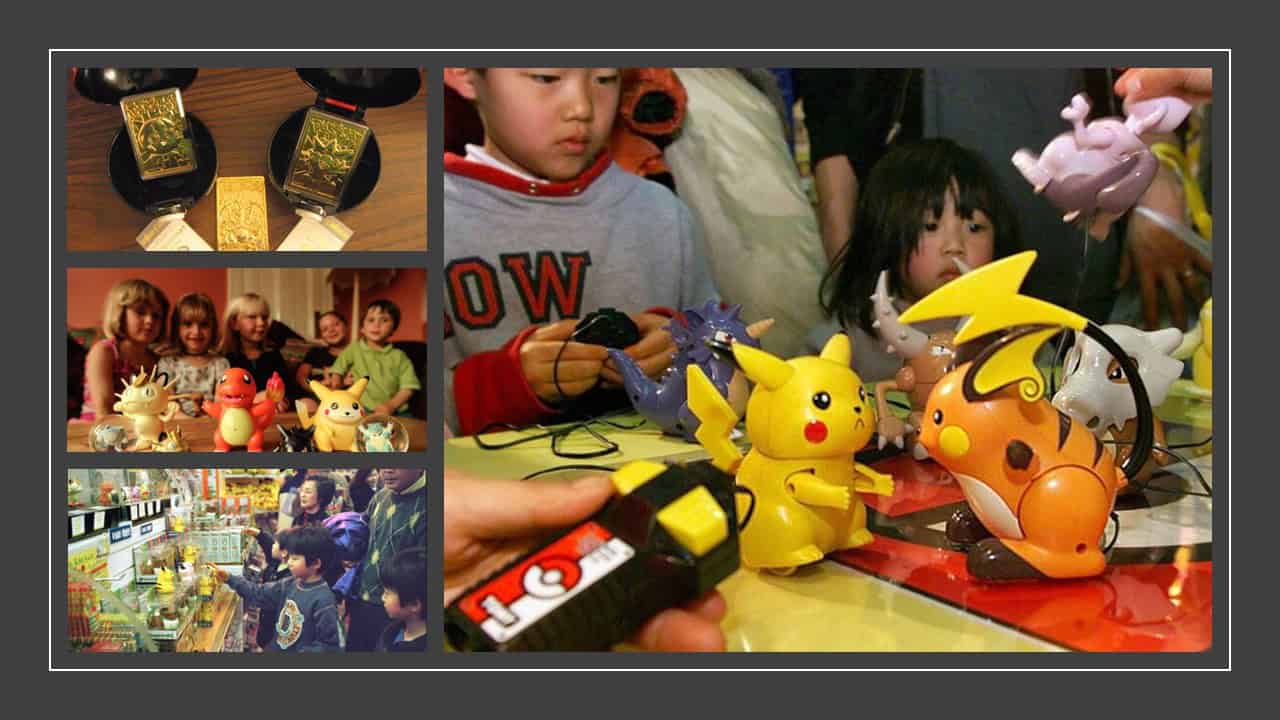
The word “mania” does imply a certain level of fun and levity, but the roots of the word aren’t quite as innocent – PokéMania was treated by many as a genuine moral panic. Tens of millions of parents the world over found that their children simply refused to do anything at all that was not related to Pokémon. The bulk of criticism was directed at something that did perhaps deserve it, however: the trading card game. Pokémon card packs were sold in stores everywhere, and could not be restocked fast enough. Buying booster packs of 11 random cards, hoping for a rare one (maybe even a holographic!), children would burn through any cash they could get their hands on, begging parents every day for more.
It wasn’t a stretch to say that an addiction was forming in some children; University of Georgia Education professor Joseph Tobin noted that card rarity was “artificially created” and “effectively a form of gambling.” Melissa Healy of the Los Angeles Times investigated the infiltration of Pokémon cards in schools and found that the cards seemed to be “disrupting learning, poisoning playground friendships and causing such distraction that some children forget their homework, tune out in class and even miss school buses as they scramble to acquire one more card.”

The cards began “turning the playground into a black market”, even finding that children were bullying each other into bad trades to get rarer cards, forcing teachers to oversee card trades. By the mid-2000s, Pokémon cards had been unilaterally banned from schools in the United States, Canada, Australia, New Zealand, and most European countries. The mania continued, however, after school hours. Western media began tracking and reporting on violent crimes that were caused by Pokémon cards. There were stabbings, robberies, assaults, knife-point muggings, and an uncountable number of shoplifting cases. These crimes were consistently committed by minors against other minors.
On the positive side, Pokémon created a single homogeneous monoculture for children from every walk of life. Kids could always find people their age to trade or battle with, whether with the cards or video games, and millions of young millennials used it as social lubricant to find common interests when meeting new people. The games were also credited with teaching children reading comprehension and introducing strategic problem solving, requiring children to read and memorize hundreds of bits of information.
Duke University Professor of Japanese Culture Anne Allison investigated by interviewing a wide swath of American parents, finding that almost none of them were worried about Pokémon corrupting their children — just confused. She contended that the hysteria around it was being drummed up by the news media and was being unfairly folded in with the recent children’s media scrutiny caused by the Columbine Massacre in 1999.
So, what could follow this mania, caused by just 151 monsters and a guy who liked bugs? How does it grow from here? The answer is so obvious, it’s almost laughable: more monsters! In Part III, we’ll dive into the creation and release of the 2nd Generation of Pokémon games, Gold, Silver, and Crystal, which introduced 100 new cute little dudes and kept the ball rolling far past what anyone could have predicted, making more money than any franchise ever had before. It is the year 2000, and the time of Disney is over; there’s a new mouse in charge. Mickey Mouse has fallen, and now, we are all Pikachu.

 ObserverCrew Picks
 bserver
 bserver