Ever since the Slay the Spire‘s explosive debut in 2019, roguelike deckbuilders have been popping up like daisies; 2024’s Balatro even won a considerable number of Game of the Year nods. Roots Devour certainly hopes to follow in the steps of games like these, but it’s almost nothing like them in practice. It is desperately trying to find a middle ground between deckbuilders, adventure games, roguelikes, and tactical strategy. The first game from indie studio Rewinding Games, it certainly lands somewhere between these genres, and while it does work mechanically, it frequently fails to capture the fun of its many inspirations.
Roots Devour is not really a deckbuilder, not really a roguelike, not really a narrative choice-based game, and not really a turn-based tactics game. In that sense, it’s extremely hard to describe exactly what it is you do during the game. It leans heavily on Lovecraftian and cosmic horror for tone and story themes, although not presented in a way that I find digestible as it is in Dredge. From start to finish, and even including tutorial prompts and menus, everything is explained via poetic cosmic horror stanzas. While I appreciate keeping on theme, this direction also made it very hard to understand an already unfamiliar kind of game.
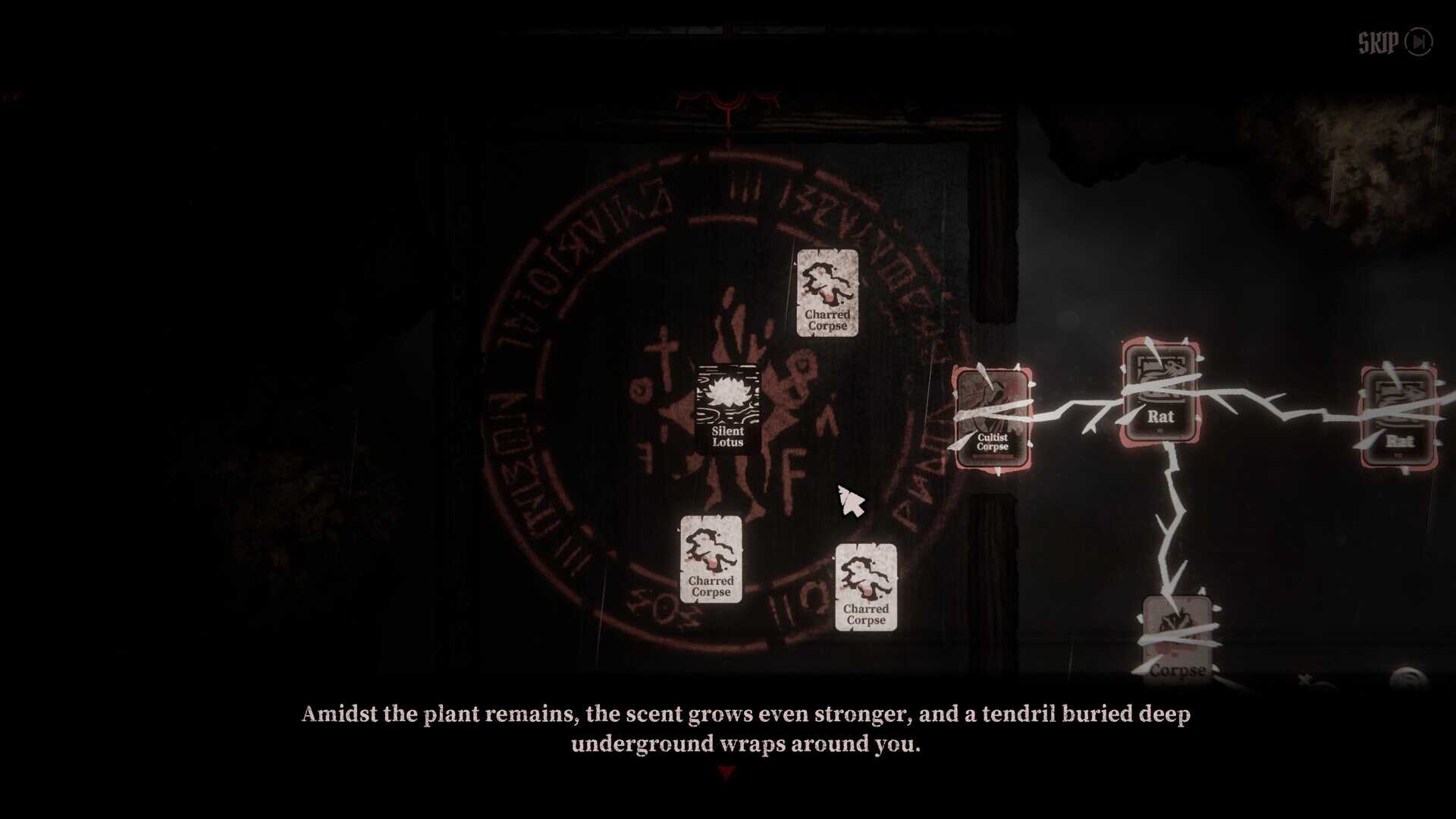
In addition to being written in a poetic way and delivered through dialogue with ancient deities and blood demons, the tutorials do a very poor job of explaining gameplay or what the player is actually even trying to do. Everything from the objectives to mechanics to structure to loadout is poorly explained, and only by playing and failing three runs did I start to get a handle of how Roots Devour works. For the first hour and a half I was simply clicking on things that appeared as soon as they did, while the game failed to tell me what the point of it all was in favor of trying to creep me out. I honestly did not like any of the cosmic horror stuff the story was going for, and found it pretentious at best and annoying at worst.
Players take control of a human who has turned into a demonic root monster who has a need for both more water and more blood, the two resources in Roots Devour. As you forget what you once were, you begin to thirst uncontrollably for blood. After a very confusing opening involving eating cultists, players are presented with a flat map where everything is represented by cards. By clicking on your demon tree and dragging a root to another card, you’ll consume it, and it will become parts of the tree. Each root connection costs an amount of blood proportionate to how long it is.
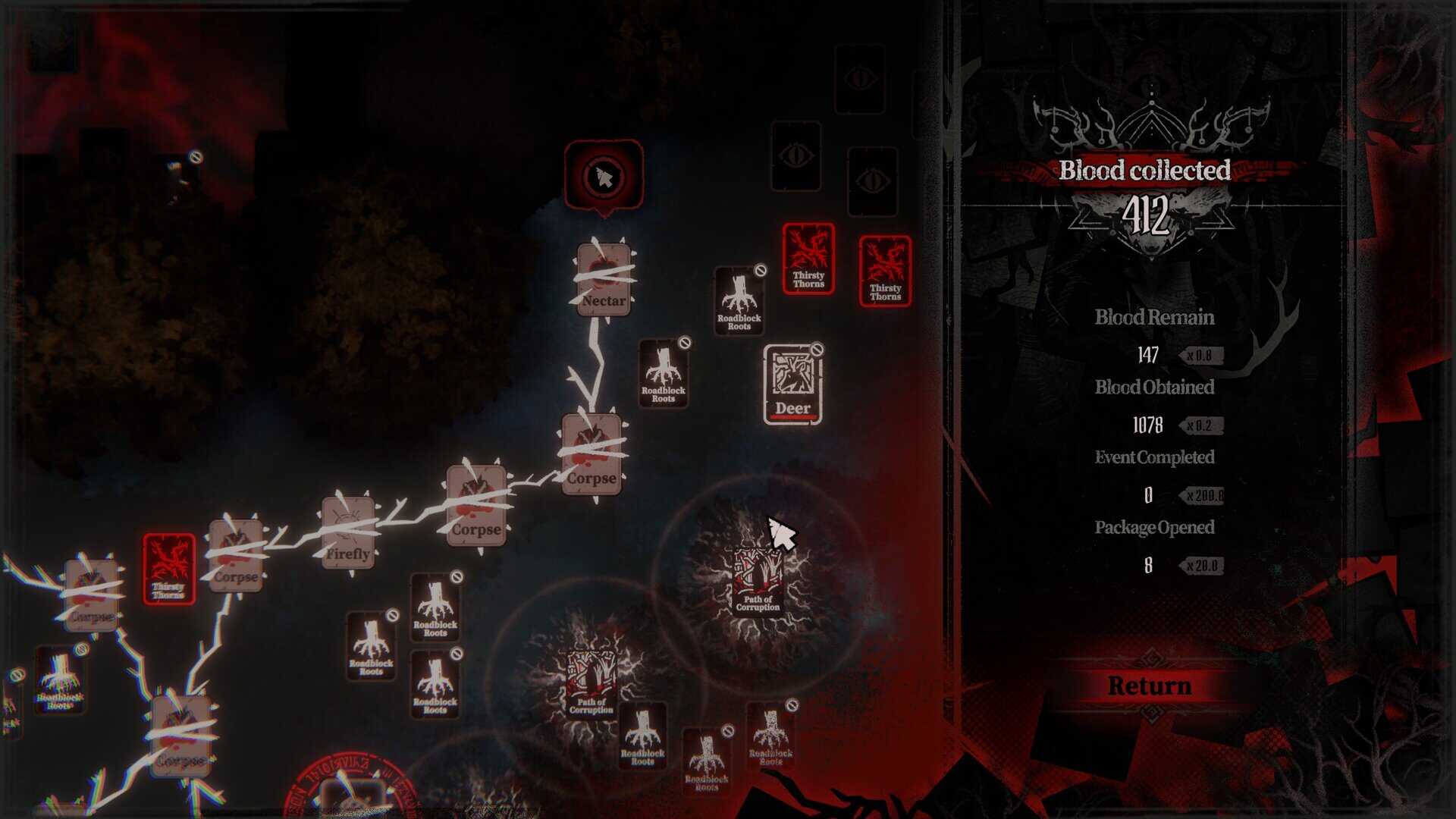
Blood is drained from the creatures you trap in your roots per second and is always draining. As such, you’ll need blood constantly fed to you in order to continue growing. However, the blood gain happens in real time, while the blood drain only happens in a turn-based manner when you choose to expand, giving you time to plan out your moves. Something like a rat might have 20 blood, where a deer might have 50, but will require playing a Digestion card from your hand to consume. You’ll also need more water to survive the larger you grow, which can be gained by finding wells or water cards. Past this very basic push-pull of your blood stores vs expansion needs, the main mechanics of Roots Devour lie in its cards.
You’ll start with a few packs of cards, three cards to a pack, in the bottom left of the screen. Card packs cost a certain amount of blood that goes up each time you use them, with free packs available as rare pickups in the world. You need to find enough open space on the map to place the pack, which is actually quite the challenge late-run, and it will release three cards, some of which are permanently affixed to the map and some of which go to your hand. Likewise, some cards in the overworld are picked up into your hand and played at your leisure, while most are static. That includes roadblock roots and rocks, obstacles that prevent you from placing roots and making the tactical part of this important – card placement is of the utmost importance.
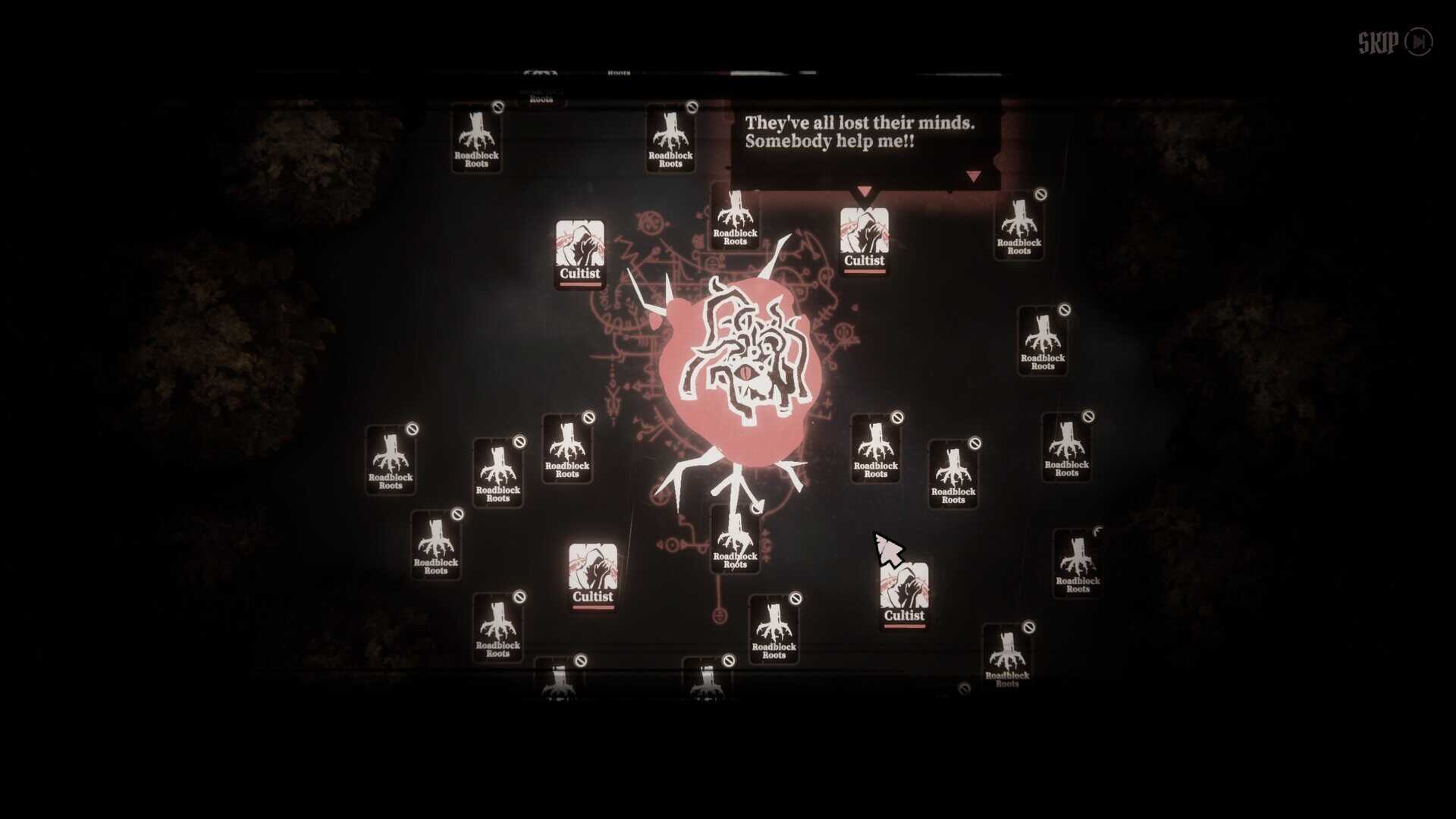
There’s not really a ton of strategy to building out the deck, because, and I can’t stress this enough, Roots Devour is not randomized. It’s the same game every time you play, even though when you die you back to an overworld with deckbuilding area and upgrade area and it points out your high scores. When you start a new run, you simply start back at the last checkpoint you found with all the upgrades and deck you picked out in the hub area. I probably shouldn’t call these “runs” at all, but Roots Devour always feels like a roguelike even though it isn’t one at all.
This structure, as I stated, isn’t really explained, so I thought I was playing a roguelike until I noticed everything was the same on my fourth run from a checkpoint. When you die, you take all your remaining blood back to the hub world and use it for passive powerups like +2 blood from snails or getting extra cards into your starting deck. There’s no real point to figuring out how far you can get during one “run”, as it doesn’t seem to benefit you in any way – you’re better off dying as soon as you get to a checkpoint so you can restock on blood, water, and cards for your loadout. In fact it’s in your best interest to die right away to bring back the most amount of blood possible to the hub world for upgrades, so I really don’t understand why Roots Devour is structured the way it is.
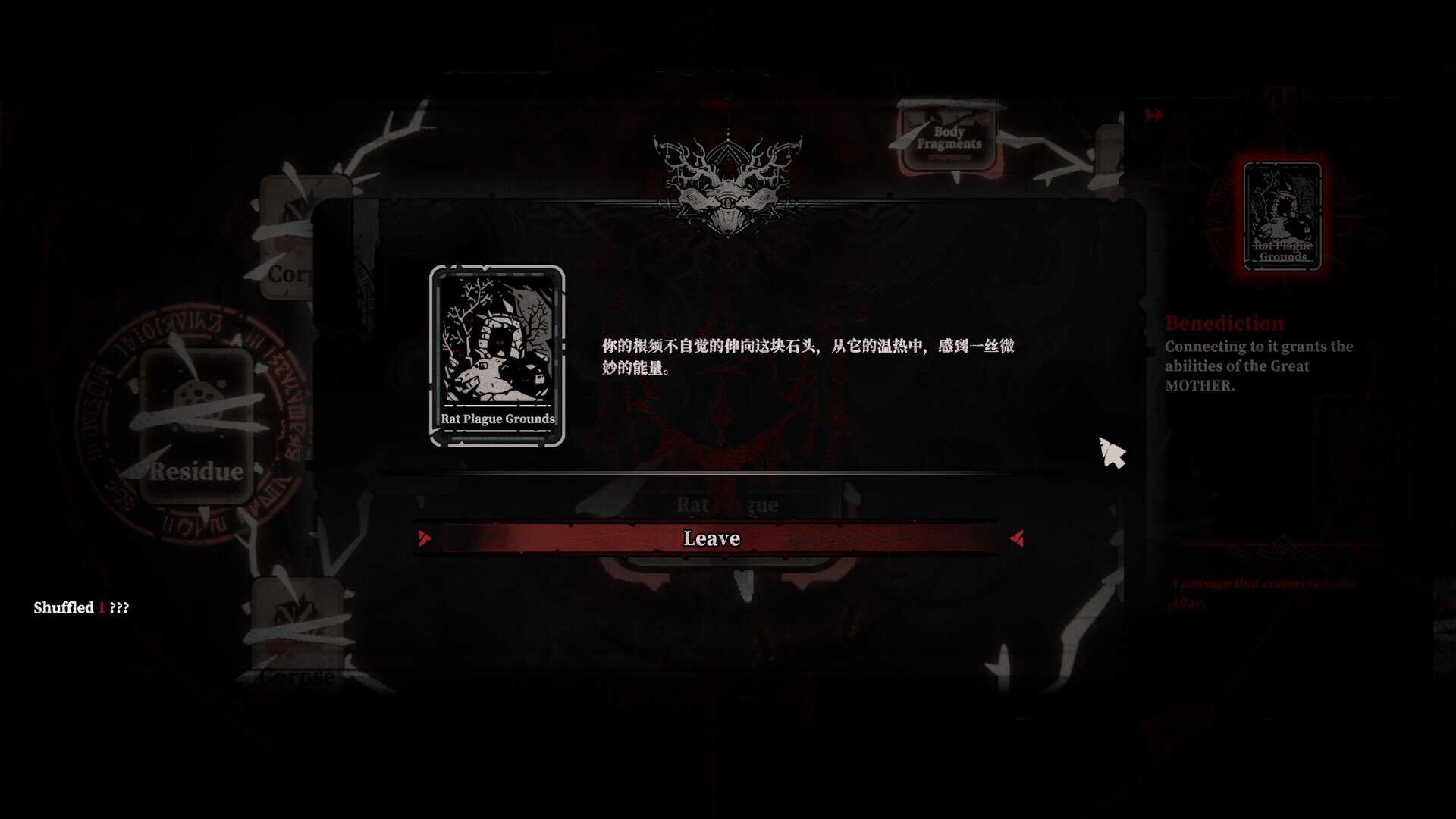
Roots Devour is unpolished. I sometimes have had to click on buttons more than once for the clicks to register, and the UI is clunky at best. The color pallet isn’t doing it any favors either, as it’s hard to read dark red text on a black background at the best of times. I also ran into many, many instances where the English grammar and spelling was broken, chopped up, or just not a sentence. There were quite a few sentences where punctuation was missing entirely, leaving behind gaps where it wouldn’t display, and a good number of capitalization errors and comma splices too. Roots Devour was made by a Chinese studio, so with this being the case it appears there was no localization done on the text. This also could contribute to why the tutorial messages are so hard to understand. In addition, I had several instances where everything from dialogue to UI appeared randomly in Chinese for one screen and then went back to English.
All that said, I’m actually impressed that the concept of Roots Devour works at all. Mechanically it’s pretty smart, and the push-pull of the blood to growth is really well balanced. I basically made it exactly to the next checkpoint each time before dying and regenerating right where I was with a bunch more stuff, with a few early deaths as I was trying to understand the rules of the game. I must admit, however, that if I was not reviewing this game I would have dropped it pretty early on. There’s a lot that works about it, and the blend of strategy subgenres is unique, but at no point did I actually have any fun. In fact, it’s an actively boring game to play. As such, I do think that others might enjoy it, but I’m glad my time with Roots Devour has come to an end.
Nirav reviewed Roots Devour on PC with a provided review code. This review is based on the version of the game available at the time of writing and our score will not be changed.
- Score
- 5/10 It's Fine - Nirav Does Not Recommend
- Summary
-
While truly unique and smartly designed, Roots Devour is unpolished, pretentious, and somewhat boring to play.
- More
- GameObserver's Review Policy



 ObserverCrew Picks
 bserver
 bserver