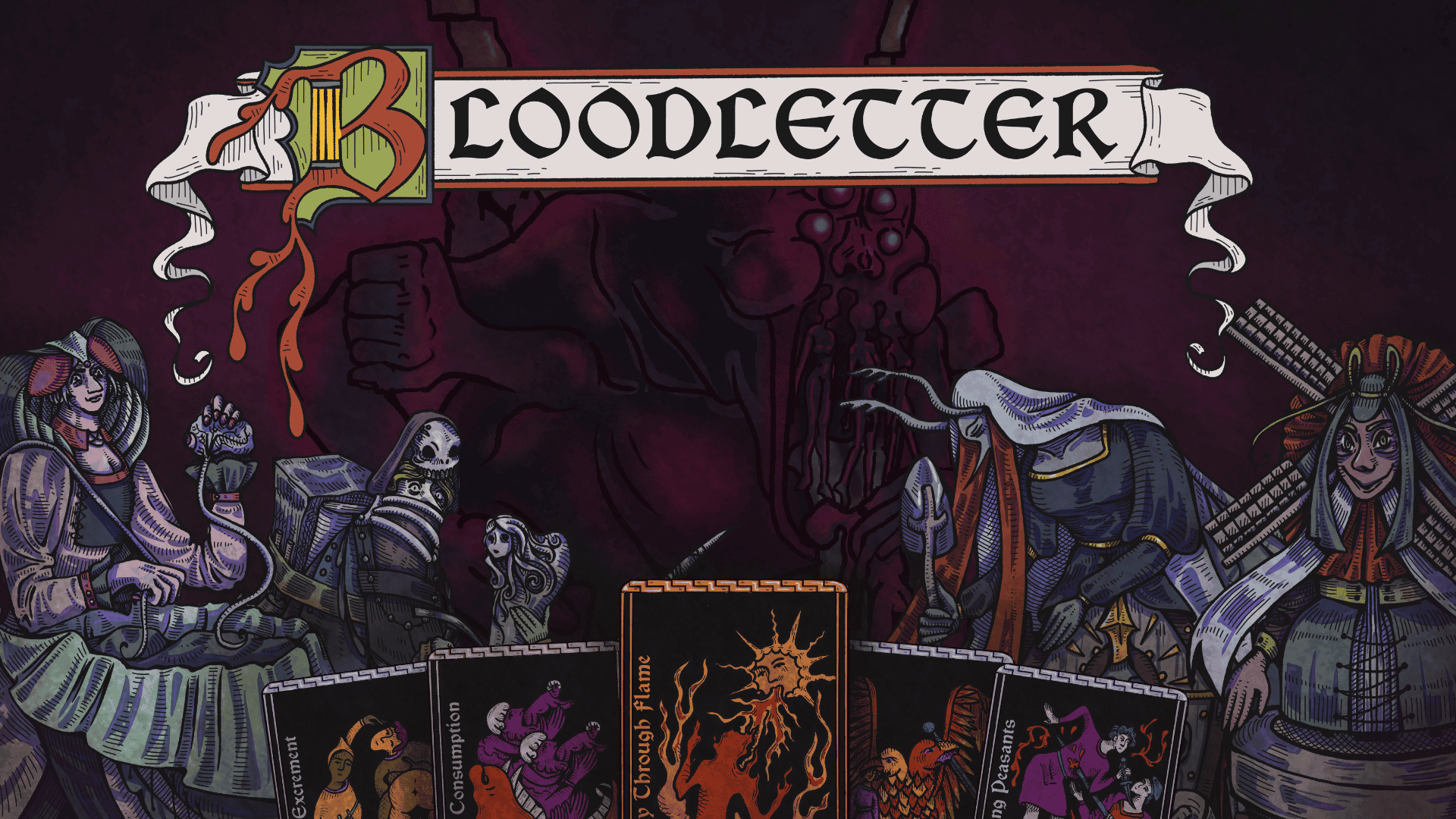
Bloodletter is a deckbuilder developed by Aldamami Games, currently in Early Access, that casts you as a medieval barber-surgeon, having freshly arrived in a village plagued by an otherworldly entity that threatens the health and spiritual purity of the townspeople. Bloodletter’s atmosphere is incredibly rich, with an art style steeped in the macabre symbolism and religious iconography of the Middle Ages. From the cards you collect to the characters you encounter, everything has the odd proportions and rigidity characteristic of the era—a style that feels all the more visceral when the villagers begin to warp into twisted, uncanny versions of themselves as the entity’s hold tightens around them.
The gameplay loop has three distinct phases: daytime, evening, and night, with the first two essentially being preparation phases to ensure your villagers survive the night. Your main goal is to defeat the entity by excising all the bloodstones from their occult idol, with the means of extraction determined by the entity you’re facing. Defeating an entity on a particular difficulty for the first time rewards you with a single bloodstone, which you can then use to unlock higher difficulties or new entities. Everyone has to face the tutorial entity first, who is basically just an easier version of the second entity, but the third entity is where the mechanics actually change. Bloodletter’s fourth entity isn’t actually available to face yet, but I imagine they’ll also have unique mechanics that shake up how you approach the daily cycle.
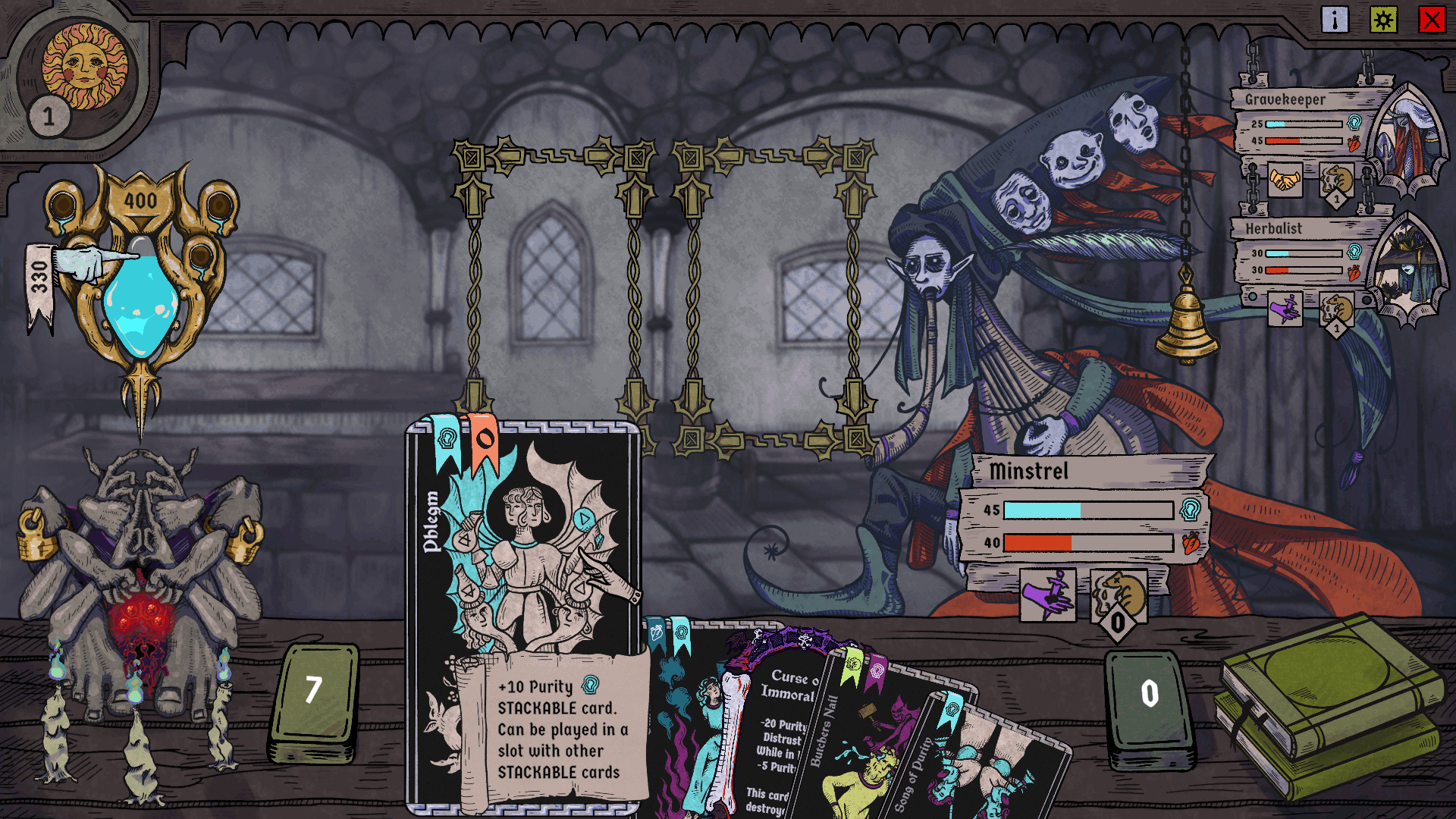
At daybreak, a random assortment of villagers will visit your bathhouse, queued in a descending order of overall wellness among them. The villagers start out at varying levels of purity, health, trust, and sickness, and keeping those stats balanced is a delicate act. Purity and health are similar in that a villager dies if either reaches zero, with the main difference being that villagers lose purity each night, while health is only lost if a villager is sick (or if you hurt them yourself). Purity and health are more immediately vital than the other two, if only because you lose the game once three villagers have died.
Trust, meanwhile, determines how many cards a villager will let you play during their turn in the queue, for a total of three cards if they trust you, or a mere two if they don’t. Since playing cards is the primary means by which you heal villagers of their various ailments, it definitely helps to have more options on hand. While it’s always better for a villager to trust you than not, some days you’ll have to choose whose favor to curry and whose trust to forsake based on who needs the most help, or whoever’s trust would be most useful later.
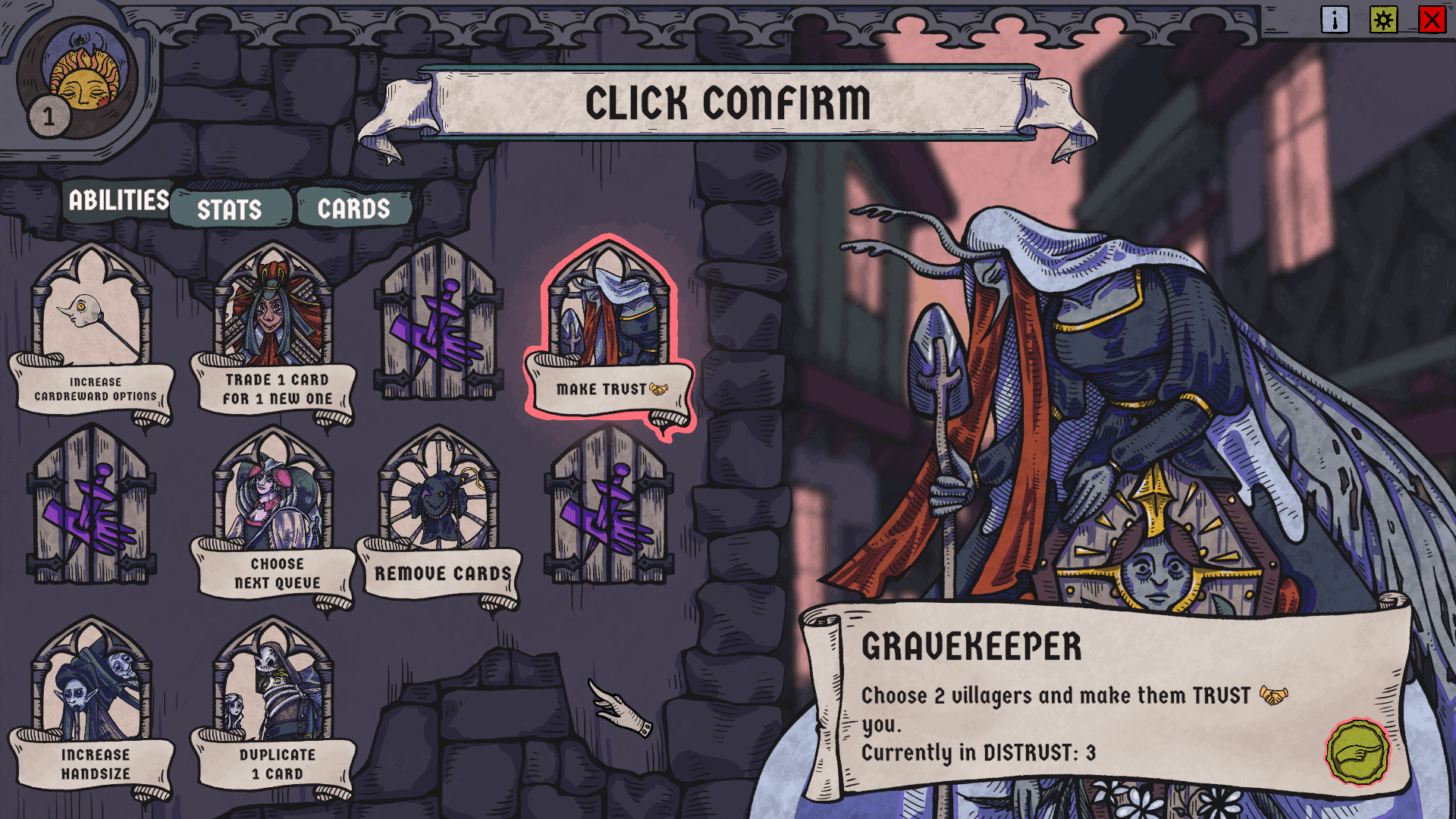
During the evening, you can visit a single villager that trusts you for a boon, such as upgrading a card, healing sick villagers, increasing hand size, or choosing the next day’s queue, to name a few. These services are largely specific to each villager, although the particular card upgrades offered by one villager might shift between visits. The butcher, for instance, might allow you to upgrade a card with ‘+10 health’ one evening, while offering ‘Discard up to one card’ the next. With so many options, it can be helpful to keep in mind which villagers perform what services, and the game does offer a very helpful compendium that lists what each villager does if you’d rather not take notes.
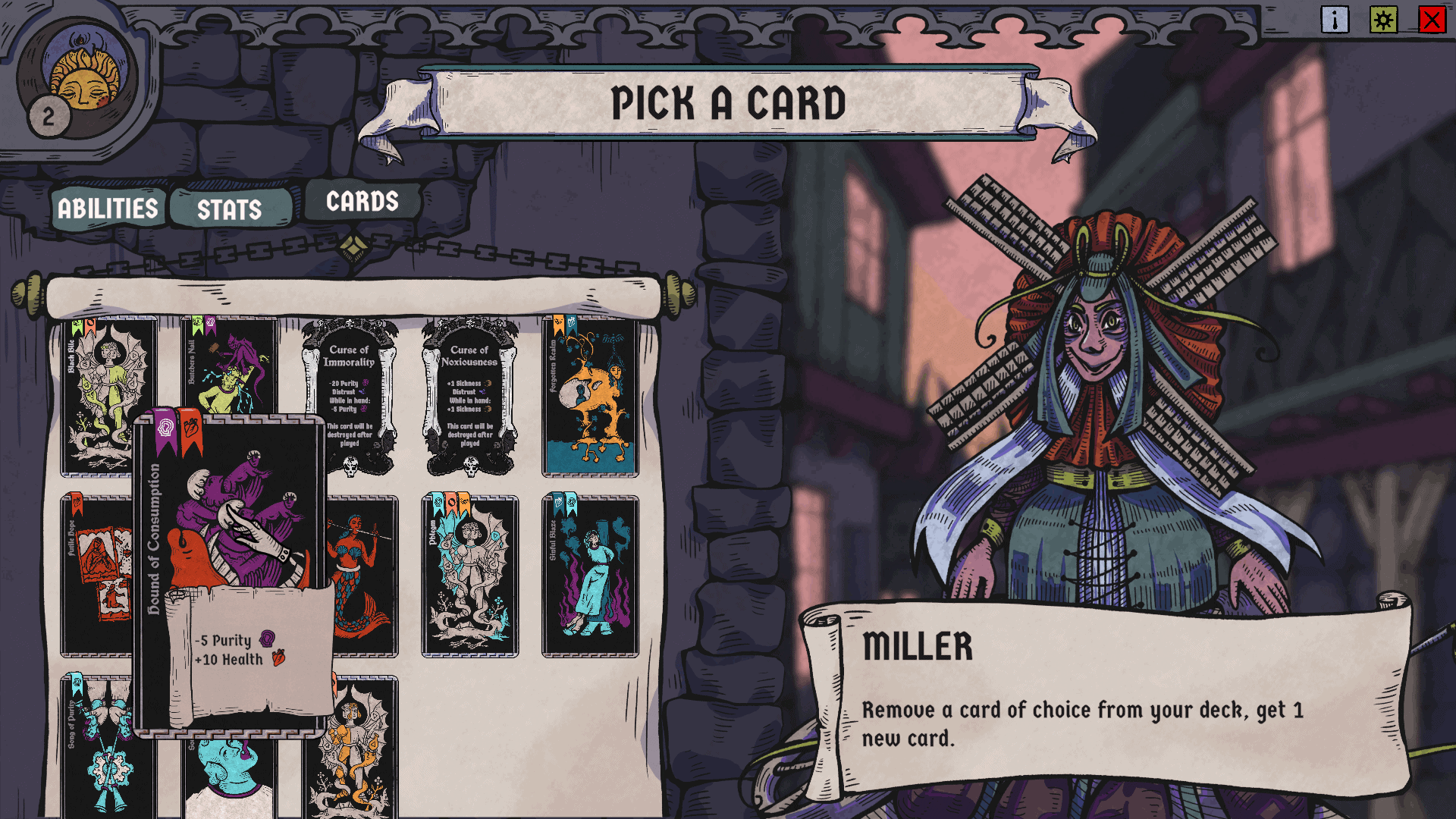
Regardless of who you visit, you’ll also choose a new card to add to your deck when the evening ends. I found this to be less a blessing and more a curse the longer a run went on, since my deck would inevitably become bloated with unwanted cards. That said, Bloodletter offers enough options for swapping or outright removing cards that culling your deck is pretty manageable. Of course, I’d always rather upgrade a card than use my nightly visit to trim my deck (and then immediately be prompted to pick a new card), but beggar-surgeons can’t be chooser-surgeons.
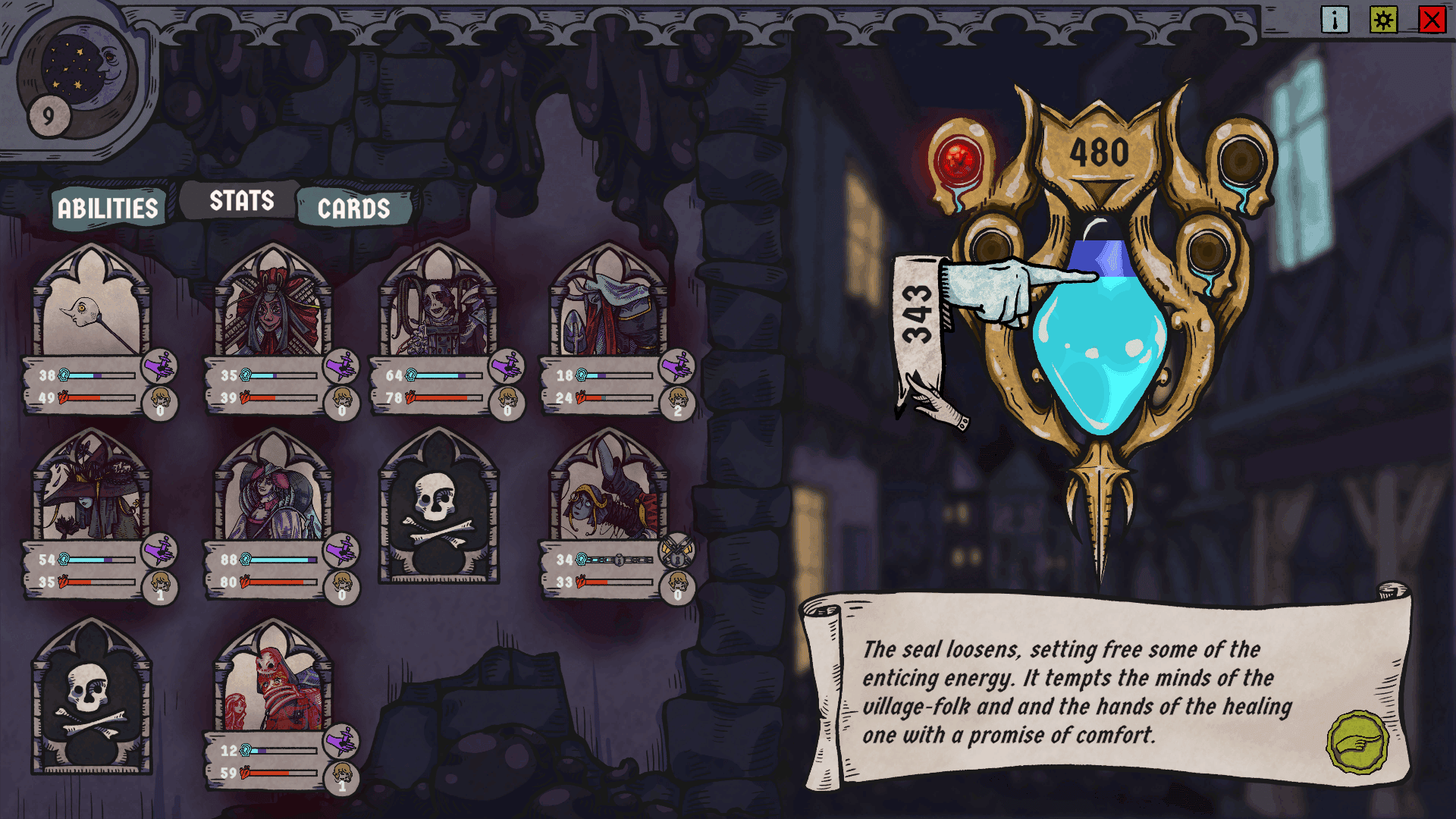
When night finally falls, the entity drains purity from every villager while sowing distrust and sickness at random. Any sicknesses that villagers had before night fell will deal damage based on the number of stacks, with a full five stacks dealing lethal damage. Once the entity has had its fun, you move on to daytime to begin the loop again. The daily cycle can feel a bit like a Sisyphean struggle at first, but you eventually unlock cards that let you ward your villagers by blocking damage to purity or health, or by averting distrust or sickness, if only for the night. Such cards are quite helpful if you have a mortally wounded villager who you’re unable to heal that day, or if there’s a villager whose service you’d like to ensure remains available the following evening even if they don’t visit your bathhouse.
The caveat to the daily loop is that you can’t treat every villager in a single day, since the most villagers you’ll have in a queue at once is five of the total ten. Since daytime queues are largely random, a villager can slowly lose health and purity until they’re at death’s door, without ever having visited you. Thankfully, Bloodletter seems to employ a bit of a pity system, where villagers who would die the next night without intervention are guaranteed to appear in the queue. In these cases, the worst-off patient being last in line made me feel like I had to hoard cards from my opening hand, saving my best healing methods for when their turn comes around. You do eventually unlock methods of retrieving cards from your discard pile or searching your draw pile, but early on it can feel like you’re fighting fate just to keep those stubborn villagers who rarely visit alive. I can’t say I’ve never put off going to the doctor myself; then again, I can’t say I’ve ever turned partially into a windmill, either.
Actually fighting an entity takes place during the day, which is the only time you’re able to extract bloodstones. The first two entities are both defeated by raising the collective purity of the village to a certain level, excising bloodstones as you reach each tier. It can be worthwhile to hold off on doing so immediately, at least on higher difficulties, since the entity becomes more aggressive as bloodstones are extracted. You can easily start to lose ground if you’re not prepared for the increased purity drain or greater sickness gain, for instance, so there were definitely times where I spent a week or so in-game upgrading my deck to prevent a backslide upon reaching the next tier. That said, I found that the third entity artificially extended my run quite well enough on its own, since defeating it relies upon multiple layers of RNG beyond just what cards you draw.
Rather than raise purity, which essentially just becomes a second health bar against the third entity, you have to upgrade cards with specific sword pieces—left, right, and middle—that you combine to extract bloodstones. This seems simple enough, at first, since there are only three card slots and three sword pieces to slot in them. I initially thought the main difficulty would be actually drawing the right cards or maintaining trust since the third entity bestows more distrust at a time (and you need all three card slots to fully build a sword), but the simplicity breaks down once you realize that there are actually multiple variations of each sword piece. Left and right pieces can have either ‘male’ or ‘female’ connectors, and middle pieces can have either connector on each side, resulting in a staggering eight variations to contend with. This is further compounded by the fact that villagers don’t tell you which sword piece they offer, only that they offer one, nor is a sword upgrade guaranteed each evening.
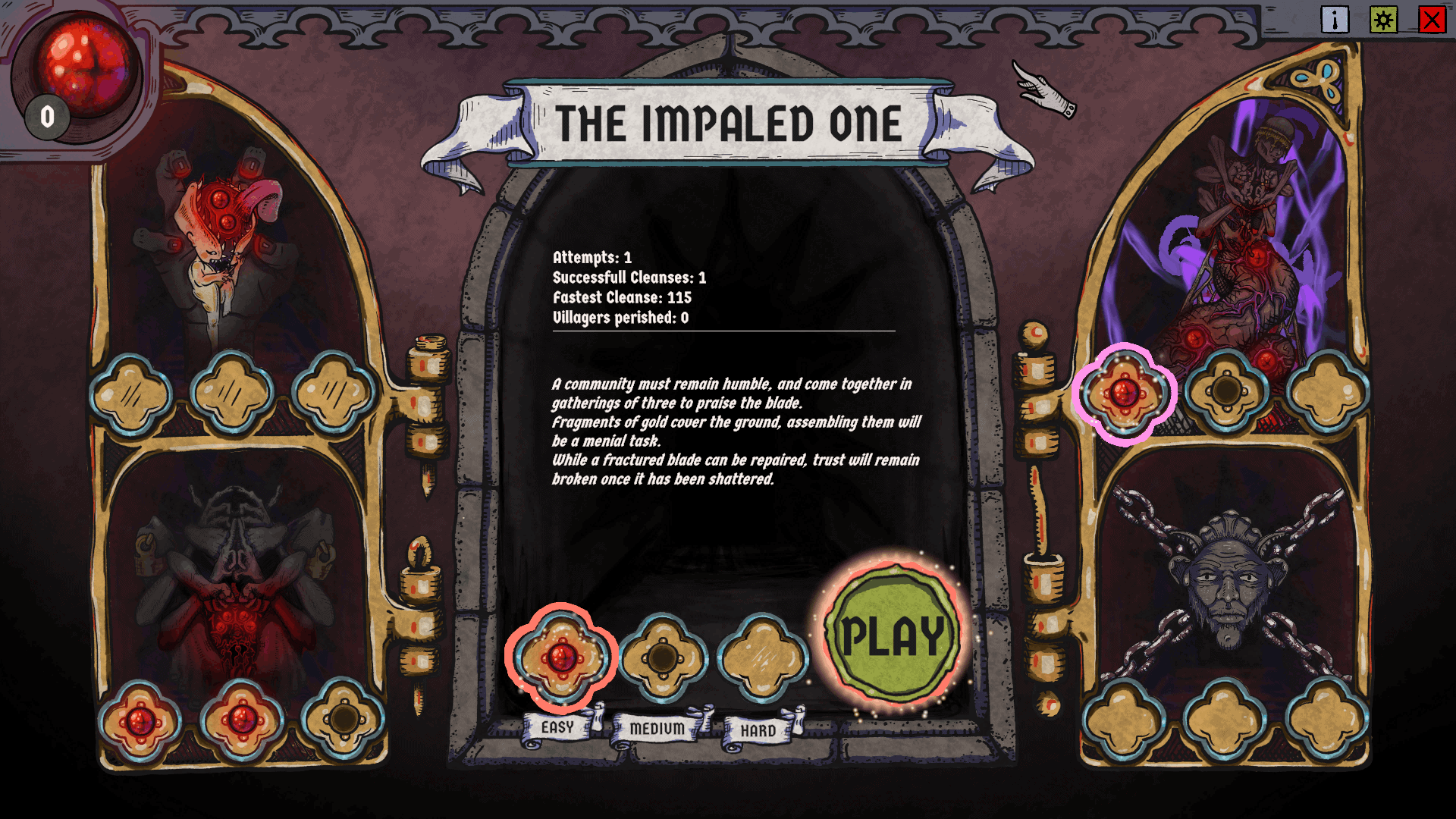
At one point, I had over twenty middle sword pieces, two right-side pieces, and not a single left-side piece. I was never in danger of any villagers dying, but it took me until day 115 to finally defeat the entity after many grueling months of bad luck, as well as a save-state bug that stole precious left-side sword pieces from me. Bloodletter takes you back to the start of the day when you exit the game mid-run, but there’s a chance that cards you upgraded with a sword piece the night prior will have simply vanished when you load back in. Having this happen to me a couple times was almost enough for me to consider abandoning the attempt, but my spite for my own misfortune fueled me through it. I suppose keeping the game open is always an option, but one that might not be available for everyone considering how long it can take to finish a run.
Ultimately, Bloodletter is a masterclass in atmospheric tension that occasionally trips over its own mechanical complexity. It has only just entered Early Access, after all, so a few issues are to be expected. There is a brilliant-but-stressful heart beating beneath its macabre exterior—one that makes every morning feel like a hard-won victory and every evening a desperate gamble. If the developers can find a way to mitigate the maddening RNG of the third entity and stabilize the save-state issues, they’ll have a truly solid addition to the deckbuilding genre. To be fair, a little madness is to be expected when dealing with eldritch beings, and it’s entirely possible fate just really had it out for me. Yet, for all the headaches a certain entity caused me, I truly enjoyed every second of my time with Bloodletter and its chimeric cast of villagers. Bloodletter’s journey is one well worth taking, just be prepared for a few missteps along the way.
Austin reviewed Bloodletter in Early Access on PC with a provided review code. This review is based on the version of the game available at the time of writing and will not be changed.
- Verdict
- Austin cautiously recommends Bloodletter in Early Access
- Summary
-
Bloodletter pairs a visceral, era-appropriate art style with complex mechanics to create one of the most atmospheric deckbuilders in years, even in Early Access. It remains enjoyable despite some potentially maddening layers of late-game RNG and issues with save-state stability.
- More
- GameObserver's Review Policy



 ObserverCrew Picks
 bserver
 bserver