Magical realism is a genre that meshes well with videogames. But too many games in this genre tend to lose their way with the magic. The best magically real stories are ones firmly grounded in realism, even if they are action RPGs about inter-dimensional beings.
If there was a studio that was executing magical realism at the highest possible level, it’s Remedy Entertainment. The Remedy Connected Universe has made ghosts and things beyond human imagination commonplace: Alan Wake and its sequel are quite literally told through the vision of a struggling author that can make his writing become real. Control is similarly ghastly, where instead of an author telling the story, it’s the collected experiences of a bureaucratic agency in the Federal Bureau of Control trying to place walls around the world of ghosts and possessed objects.

But like any fictional universe that grows and grows, it becomes impossible to contain inside its current environment. The Oldest House, the headquarters of the Federal Bureau of Control, is a finite space. And when that space runs out, it’s time to take the story outside. Remedy takes everything great about the original Control and flips it, reverses it, and thrusts it out into the open world of Manhattan in Control Resonant. Not every mechanic survives the journey, and it’s hard to say that the opening section starts Dylan’s journey off on a great note, but most of Remedy’s creative choices sing to create a bizarre, expansive world that’s worth exploring.
In Control Resonant, alien threats previously kept inside the Oldest House’s containment have broken free, joining a new alien entity that has turned Manhattan at large into an optical illusion. To stop them from wreaking havoc across a now M.C. Escher-ified Manhattan, Control’s (2019) protagonist Jesse Faden, inadvertently enlists her brother Dylan in the fight – who many perceived as the villain of Control. What follows is Dylan Faden’s attempt to wrangle these ghostly entities back into the DoC’s custody to save the city, convince the FBC of his noble intentions, and find his sister Jesse in the process.
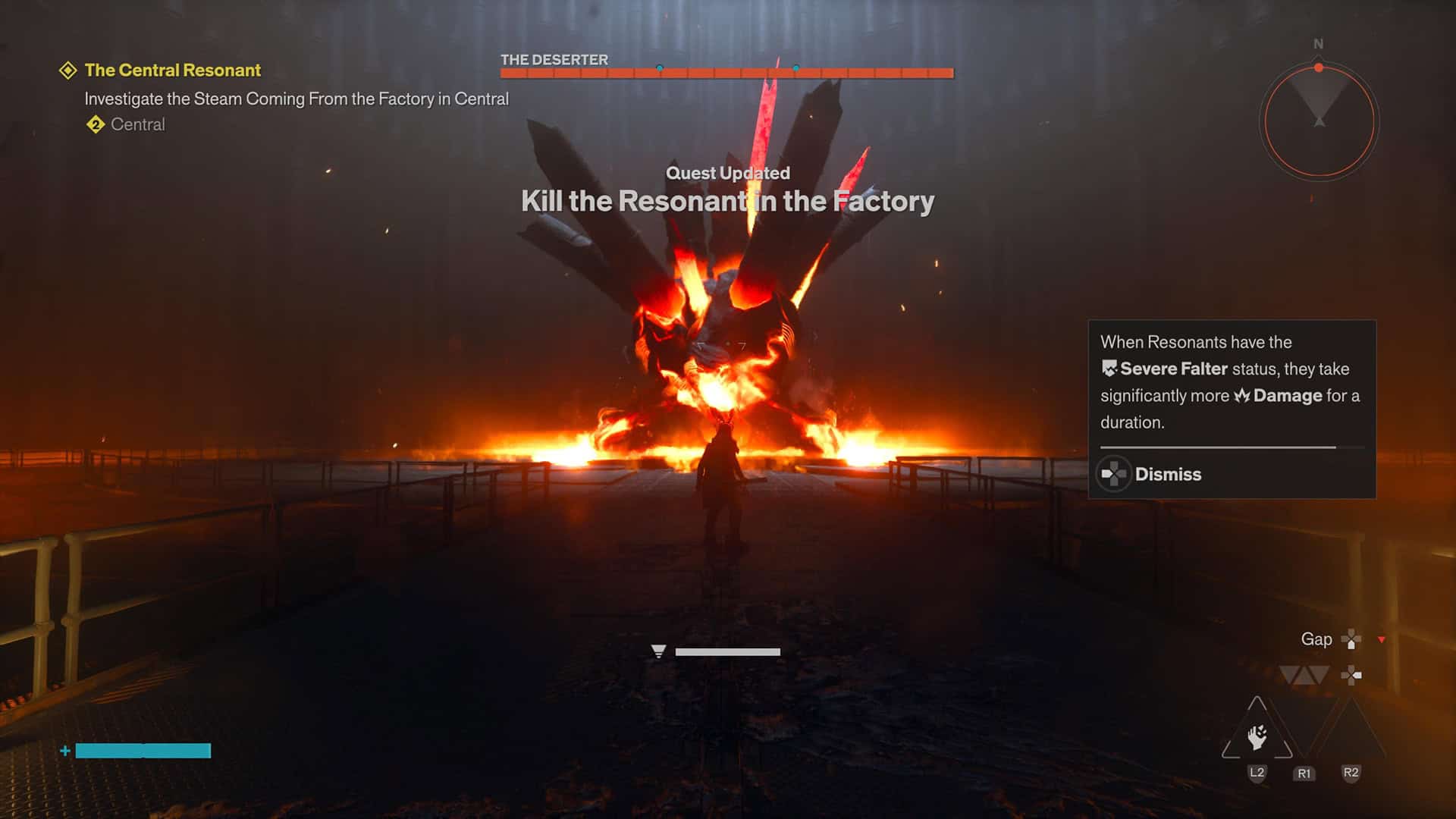
As Dylan starts his journey to try and calm down a now “patterned” Manhattan – where buildings are flipped onto themselves and gravity constantly shifts – Remedy has a hard time at first giving the player the keys. The beginning three hours of this game felt like an absolute slog as I made my way through the opening “resonant” bosses to unlock new abilities. Each combat encounter was a dodge and click the attack button simulator for two to five minutes at a time, with few instances where Dylan could experiment with his newfound powers.
Rather than Jesse’s gun – the Service Weapon from Control – Dylan is given the Aberrant, a flexible piece of metal that can form itself into daggers, a scythe or a larger sword depending on what the player picks at the beginning of the experience. The Aberrant also has secondary weapon forms like a large hammer, as well as finisher combos that players can customize. This customization is essential as the world opens up. Control Resonant replaces its predecessor’s focus on cover shooting with a Devil May Cry-esque melee combat system, where Dylan must dodge enemies attacking from all directions while chaining combos together. In the first couple of hours, this feels less like a delicate dance but more of a cumbersome series of obstacles to push through. But later on, after unlocking abilities that bypass certain enemy defenses and allow for summons, there’s far more experimentation and firepower that Dylan can use. Only then does the combat truly sing.
But judging the combat alone is something that’s ultimately destructive to the gameplay experience of Control Resonant. For Dylan, his combat abilities are something of a foregone conclusion. A refresher of his backstory reminds players that he was taken into FBC custody early in his life, groomed to become a director of the Bureau. The beginning of his journey in Control Resonant is him slowly coming into his own as someone who can enact change on the world. Combat is the go-between all of the in between – the world, the journey to get to Jesse, and the fate of Manhattan.
It feels reductive to call the combat of a game the set dressing for – well, EVERYTHING ELSE that’s going on, but everything else that happens in Control Resonant screams magical realism. For starters, the world of Manhattan is intricately detailed and holds so much wonder in how it makes the familiar feel unfamiliar. I could devote an entire piece dedicated to the billboards alone, how they are like an island of normality among a sea of buildings folding in on themselves. From Max Payne to Alan Wake 2, Remedy Entertainment has had a strange history with representing New York City as a kind of memory version of a city – a city without any defining features that you might think of when you think of New York, but what your idea of a city block in Manhattan might look like. That’s nowhere more apparent than in Control Resonant. Delis line the streets that look like a street corner you’ve seen in a dream, and the same goes for signposts, billboards, and laundromats that feel vaguely familiar but I could not quite place. I don’t think any of these cityscape features could feel quite as normal as it does in a Remedy game, because as you might expect, the landscape quickly becomes abnormal.
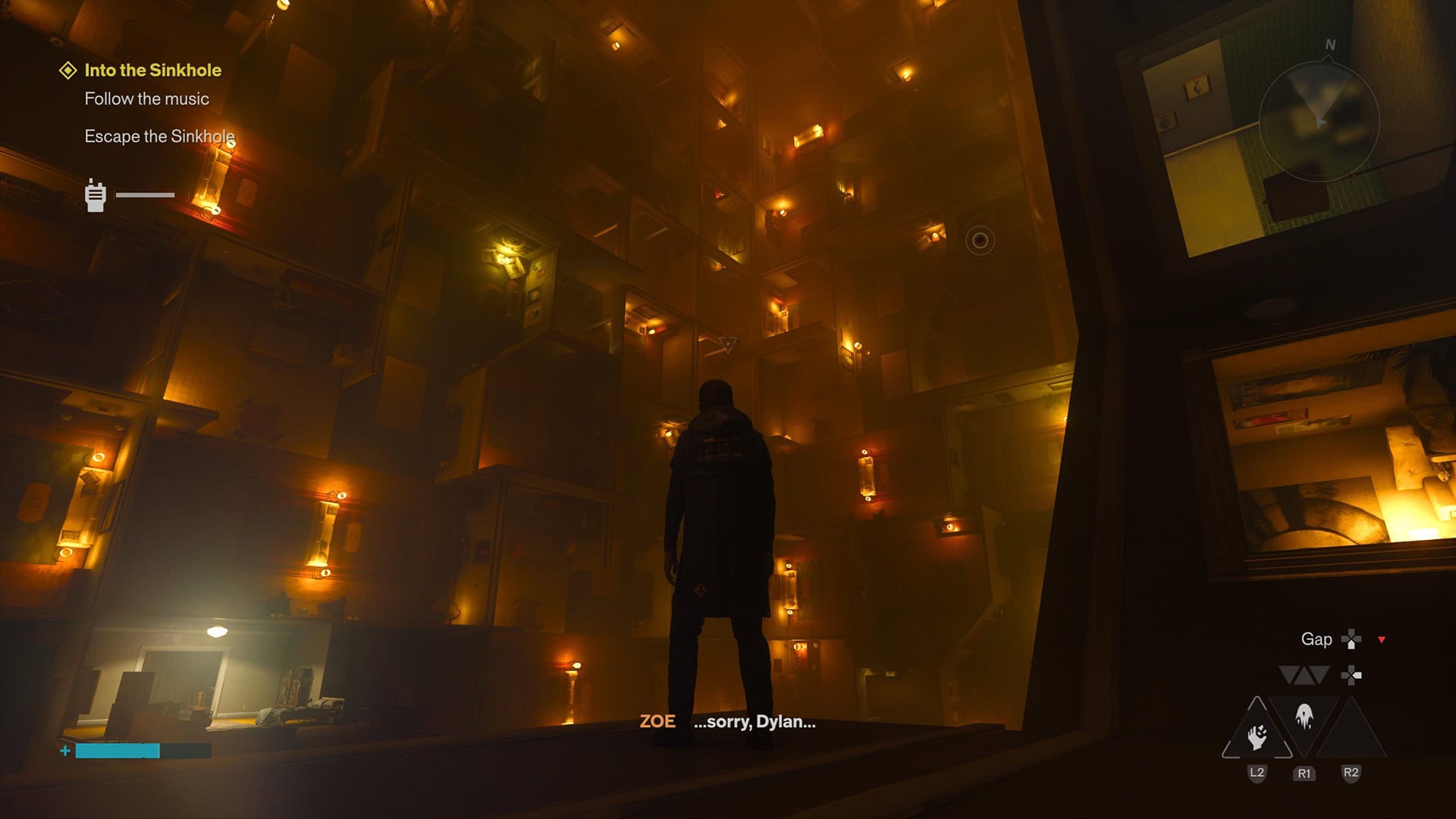
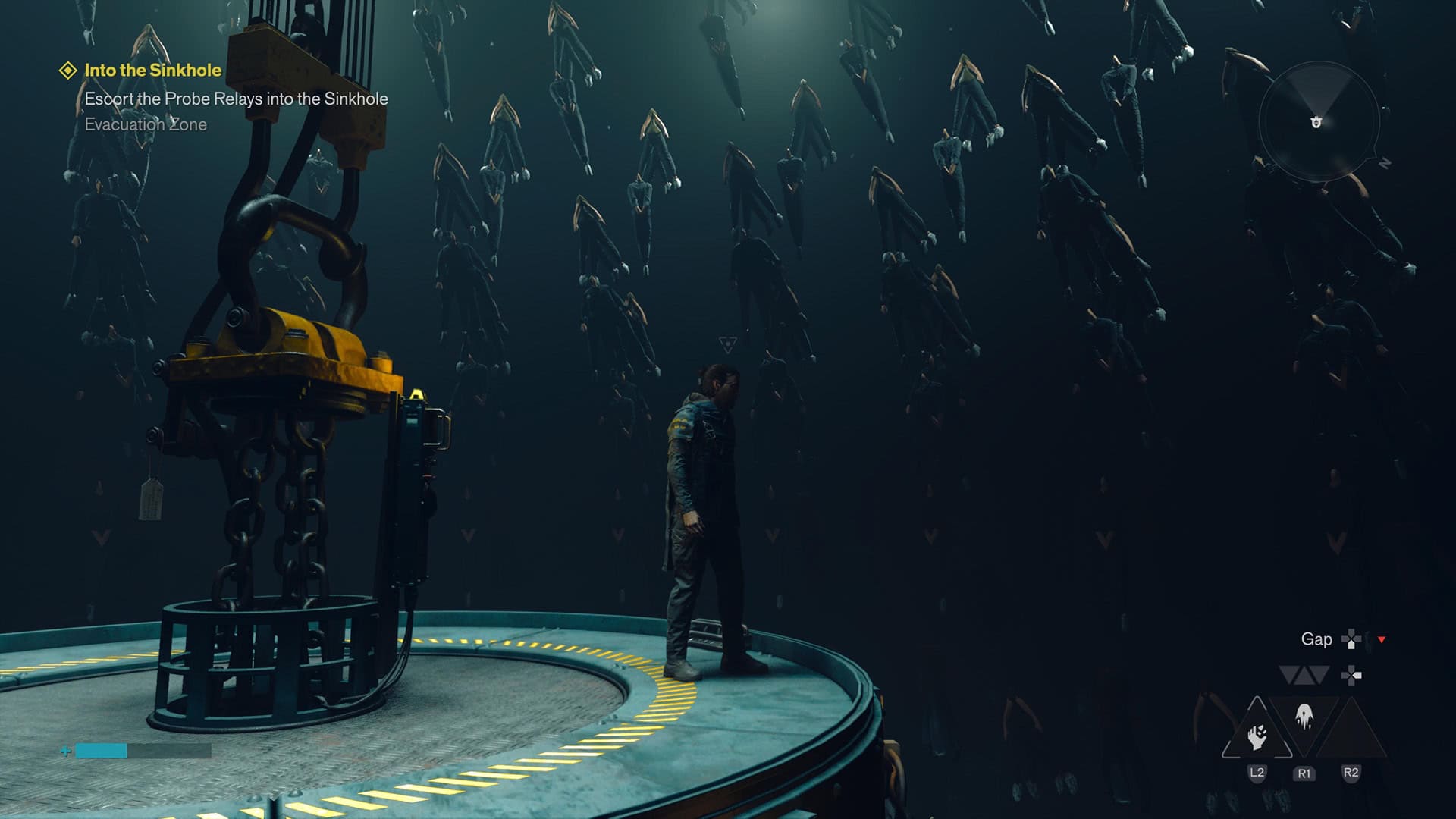
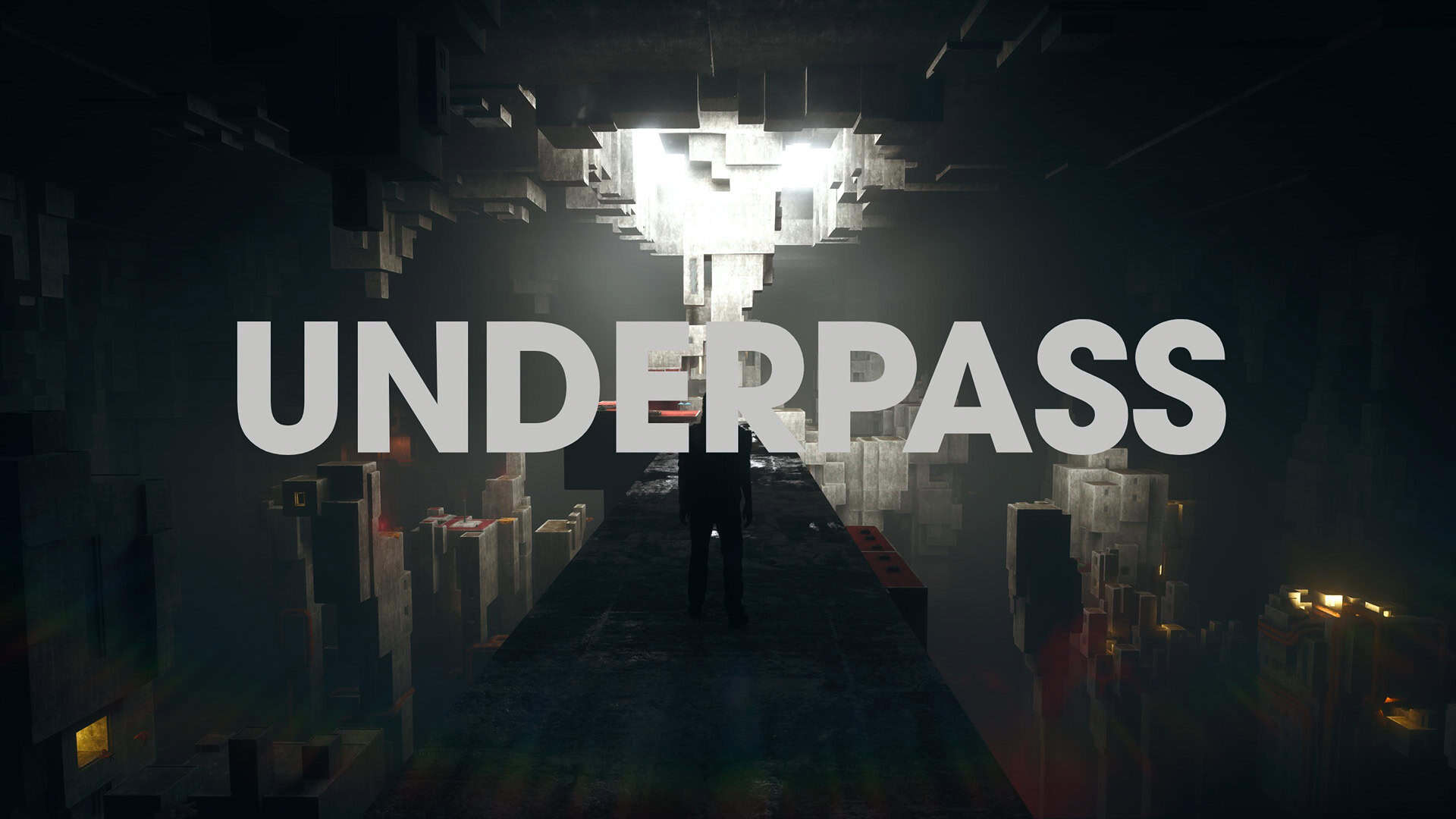
The new “paranatural” threat that’s escaped the Oldest House has sectioned off different districts of Manhattan – while also reworking the laws of physics and turning the city’s geometry in on itself. The results are some of the most awe-inspiring representations of scale that I have seen in a videogame world. A standout area is the Underpass, which players reach roughly at Resonant’s halfway point. In sharp contrast to the city streets underlying every one of Dylan’s movements, the Underpass contains vast stretches of void in between brutalist pillars of buildings. The brutalism from Control translates beautifully to its sequel, and it’s always rewarding to find the beauty in the harsh angles and the drab grays thanks to some great lighting technology. Other areas like the folded West Incursion Zone and the dark Evacuation Zone also have distinct visual identities that make these environments so striking.
After unlocking a few of Dylan’s abilities that enable him to levitate and flip gravity, the player is given free rein over most of Manhattan to explore these areas while pursuing side quests and main quests alike. Control Resonant gives players a surprising amount of freedom. If players want to focus on combat, they can do side quests to help people stranded in the city that give Dylan resources to upgrade his combat abilities and equip new gear. If they want to focus on the story, they can do that too by poring over every readable file and videotape that FBC employees and others have left behind.
But I think the craziest thing by far about Control Resonant is that all of this visual fanfare and exciting combat is a smokescreen for the best part of the story – Dylan. Dylan Faden is a character that was previously the avatar of the villain in Control, a vessel for the blood-red Hiss entity to use as it pleased. In Resonant, Dylan fights tooth and nail to win any resemblance of a reputation back. He encounters characters that are willing to give him the benefit of the doubt, such as headset companion Agent Zoe de Vera, and others that spurn him at every turn, like security chief Simon Arish. Through this initial sense of distrust we are told to reject any attempt at empathizing with what Dylan did in Control – which he says as much.
The rest of the story explores Dylan’s trauma. Various text and video files show Dylan was captured, experimented on, and ultimately traumatized by the Federal Bureau of Control. Previous FBC employees like Head of Research Casper Darling (played by Matthew Poretta, the voice of Alan Wake) that we looked on positively now have a much darker tone to them. Even Jesse herself gets recontextualized through Dylan’s point of view. Control Resonant is such a standout entry in the Remedy Connected Universe because it deepens its lore without necessarily adding more of it. Every assumption about Control’s pre-established characters, logic, and worldbuilding are thrown out the window and into the open air of the Manhattan skyline, and it is ultimately better for it.

Control Resonant is the latest proof that few other developers are doing it like Remedy Entertainment. The worldbuilding is superb, the story is engaging, and even if every gameplay mechanic doesn’t fit right and may require patches to fix its balance, the studio at least takes big enough swings to be proud of. In an industry that sustains itself on remakes of existing franchises and carbon-copy sequels, it’s refreshing to see a studio take leaps of this magnitude and hit on so many of them. In short, I adored Remedy’s depiction of the outside world gone haywire.
Jack reviewed Control Resonant on PlayStation 5 with his own bought copy. This review is based on the version of the game available at the time of writing and our score will not be changed.
- Score
- 8/10 EXCELLENT - GAMEOBSERVER RECOMMENDS
- Summary
-
Jack: Control Resonant is another standout entry in the Remedy Connected Universe. It's a big swing for a studio that keeps expanding their genre tastes, and while not every action-RPG mechanic lands as intended, the world they realize in Resonant is remarkable and unforgettable.
- More
- GameObserver's Review Policy






 ObserverCrew Picks
 bserver
 bserver