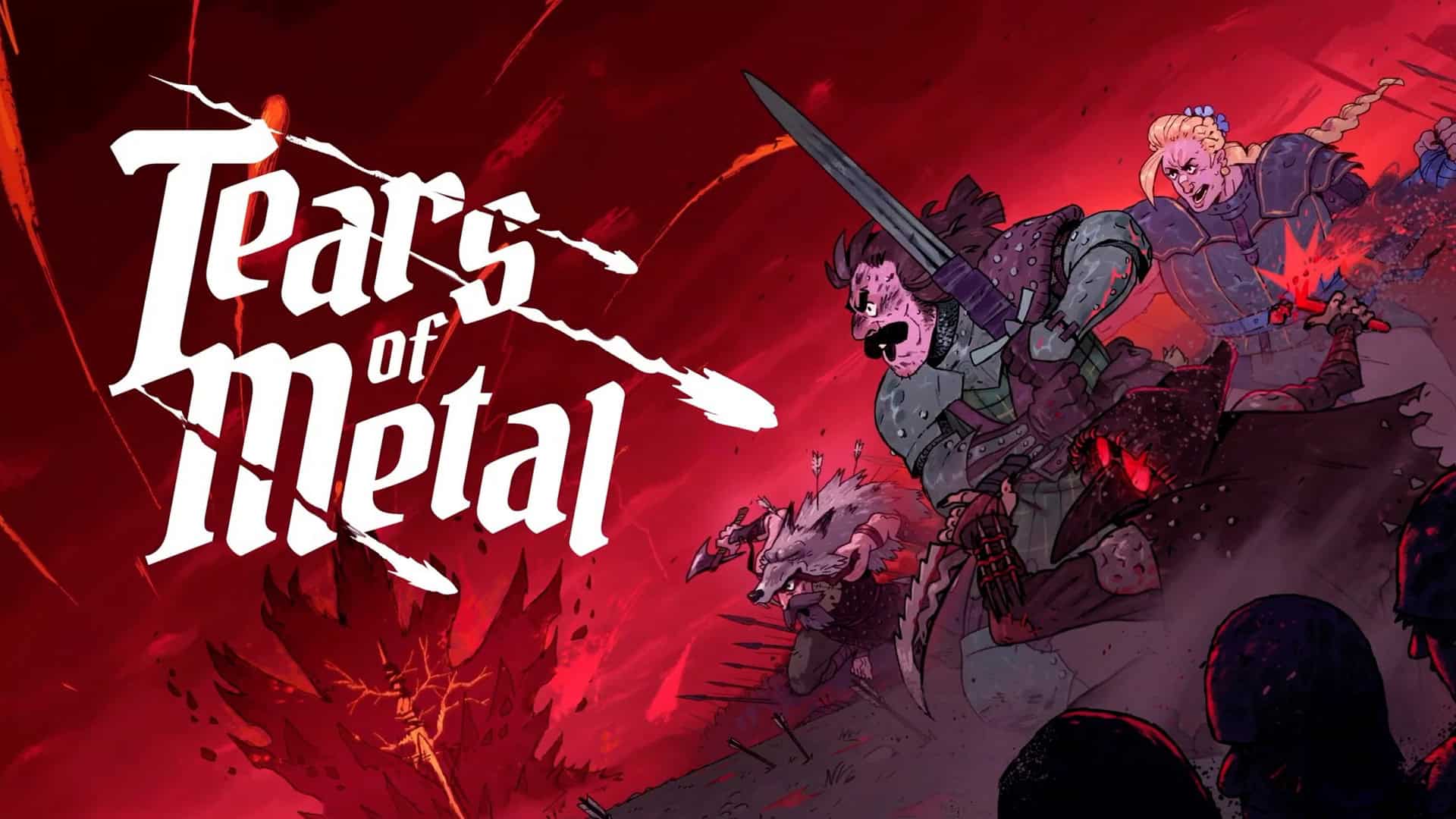
I find myself in this spot all too often. I get enamored with a game from the initial footage, notice that it’s a roguelite, and think to myself, “this one will be different.” Tears of Metal was originally revealed at The Game Awards back in 2024, and it was its directness that won me over. The trailer full of brutal action and heavy Celtic music concluded with three burning words: roguelike, co-op, hack’n’slash. I know it says roguelike right there, but it’s a -lite, ok? Stay with me for now.
My luck when trying out roguelites these past few years has not been great. To the point where what was once one of my favorite genres, one that I checked basically every new title from around the late 2010s, has by now turned into something I’m questioning picking up any time I see the tag. I’m not entirely sure whether it was any one title that caused this shift in style, but Tears of Metal falls victim to what keeps pushing me away. The good news is, it’s starting in Early Access. A lot can change down the road.

The beginnings are smooth and innocuous. After witnessing one of the best start screens perhaps ever, you jump into the musou-style army-on-army battles (that will ultimately pale in comparison to the late-game hordes) and control a single hero that must chop down commanders to conquer points on the map. Learn the utility of your combos, enemy movesets, and the dodge. Eventually you’ll figure out that blocks and parries are useful too if, like me, you’ve been playing too many pre-parry era soulslikes lately. Why take a hit when you can use my invincibility frames? Well, it keeps you in close distance so you can execute longer combos!
A few runs that failed before I even reached my first real boss feel almost like an embarrassment with all that I know now, but I was still using the starting hero: Wallace. Things picked up quickly when I got my hands on the second character—the combo-based Brienne—at the start of the second act. Though it took me, again, embarrassingly long to realize that, at the time I finished the game, she was completely busted. Throw away the lesson you learned about blocking—Brienne has a dash that regenerates so quickly that with an unlockable piece of gear/an upgrade or maybe two, you can spam it and be completely invulnerable to damage.

Thankfully, this realization came late, and I got to really dive into the game fair and square throughout my 23 hours. At the moment, the game is playable from start to finish, featuring three acts, three bosses, and three out of five playable characters. What’s meant to follow is two more characters, new upgrades and in-run rewards, more voice acting, and better balance. Unlike other recently popular Early Access releases, where we’re yet to see the story’s final chapter, playing Tears of Metal right now is a full experience; if you jump in, it’s to take part in shaping the game for future players through your feedback. Here’s some of mine.
The first thing that led me down a familiar roguelite spiral was the meta progression. More precisely, the currency required to grow your troops, unlock new events, or lower unlock prices. Having to choose between the quality of your current run and those currencies as rewards for clearing a node on the map is my greatest gripe with modern roguelite design. Interestingly, Tears of Metal both tries to make these choices more interesting and further exacerbates them.

You can choose to visit extra locations instead of traveling straight to a boss, and traveling through two nodes increases the campaign’s threat level. Enemy troops can better prepare for your arrival the more time you take. So, the more spaces you visit, the more commander units will spawn on the battlefield, bosses will get more health and damage, and special events may interrupt your fights. This, in theory, can make even early game runs, when you’re out there maximizing profits by collecting every currency, feel like a real challenge. In reality, the system was a huge disappointment.
One of the events makes stones drop from the sky that buff every commander unit on the map by giving them more health, defense, or damage. All you have to do to get rid of it is abandon whatever it is you’re doing, run to it, and smack it a few times. Then, you have to run back. It’s similar for timed objectives. These are just mere forgettable annoyances, but if you do reach high enough levels and the act’s boss, they become an absolute nightmare.

Tears of Metal, despite its eye-catching, thick-line comic aesthetic, has a real clarity issue. The aforementioned result of maxing out a campaign’s difficulty, the one time I did reach it, resulted in the boss encounter being filled with pillars of flame that covered an already incredibly busy screen. Each unlocked item covers up the top left, your combos and abilities cover up the bottom left, the map and current list of objectives cover the top right, and your squad of soldiers and companions, growing with each unlock, covers the bottom right. Everything in between is manageable at the start, but turns to chaos by the third act.
The waves of enemies are one thing, but the effects you leave as a result of your in-run upgrades proved equally difficult to parse. The game’s disappointingly uninspired elemental system leaves behind trails, explosions, and all sorts of other effects. Poison’s green, air is blue, fire’s red. Other bonuses that rely on luck, linking enemies for multi-man hits, and damage manipulation are fortunately much less overwhelming, and fit the game a lot better as a result. Enemies with area-of-effect attacks will usually indicate them with red circles, and most late-game areas in general have a red theme going on as a result of the proximity to the giant, magma-spewing chunk of rock that fell on Scotland, corrupting the invading English armies. It looks awesome in screenshots and trailers, but it turns into a proper mess.

Your troop leaders can die, indicating they’re under attack without an audio cue, only a quick pop-up that may get cut off when you use a special attack that cuts off the bottom and top of the screen for a cinematic shot. Otherwise, they do have a danger sign over their head, but why would I be spinning my camera to check on them when there’s a commander right in front that can also ruin my run?
Enemy attacks, unless they’re special, guard-breaking ones, are indicated with these relatively small white lines above their heads, and a quiet grunt if you’re lucky. Between all the visual and sound clutter, the faster commander units blend in and chop off a fifth of my health with a barely visible double strike. Then another. Then another. Before I knew it, I was out of money for a healing shrine, if I even got one on the current level, and it was back to the beginning.

And, it’s not like I don’t enjoy a bit of chaos. I think putting myself in a situation where I got overwhelmed was often a tactical misstep on my part, but the reason why I stopped thinking has to do with how mind-numbing the game gets. The soundtrack goes hard, but the number of times I heard those opening riffs numbed me to their excitement. The attacks are fun to dodge, but if you aren’t being swarmed by enemies (or your own elemental attacks), they’re really generous with reaction time. The first act and a half quickly become little more than a chore, even without taking upgrades into account.
But the temptation of the currency is strong, even though I know just how much going for them screws over my run. I don’t want to fight a boss with even more visual clutter, but that sweet damage bonus for my troops won’t unlock itself! Currencies are unique to their acts, meaning that to unlock events to make runs more enjoyable, you have to reach the corresponding act and pick the path leading to it, even if it might take you off a path with a heal reward that might save your run, while also providing no benefits to your current excursion after clearing it.

For this to work, there needs to exist a trust. I must trust that the game will unlock something exciting with these currencies. That it will reward my choice to effectively sabotage a run in favor of experiencing more of what it has to offer. It didn’t. There are seven unlockable events. I don’t think I remember more than one popping up in all my time playing. Everything else is just an increase in health, damage, or unit slots, all difficult to even feel the effects of during the fighting.
Whether it’s an open field, a castle corridor, or a small town, every encounter felt the same. I was just straining my eyes and ears in hopes of spotting enemy attacks from the masses in front of me, differentiating the red circle from my own fire explosions, hoping the lock-on works without flipping to an enemy elsewhere as I get hit in the back. Bosses were a highlight only in theory, as their relative clarity becomes a welcome rest period. They’re way too cool for me to feel nothing when fighting them. And yet.

Tears of Metal, on launch, just isn’t rewarding the trust you put in it. Its meta progression consists of dry numbers. There’s no preparation aspect, but the randomness is also fairly limited. The things that are meant to spice up the gameplay are mostly annoyances. It’s difficult to appreciate its audiovisual strengths because of the clutter. You can’t really control the difficulty yourself because the special events are mostly random, and the permanent upgrades cannot be turned off. Fights with different enemies often feel like going through the motions.
As with most games, hopping into multiplayer can be fun, but at launch it was immensely difficult to go through an entire run without losing connection, without an ability to return. Even getting into a game proves a challenge, as there’s currently no way to remove in-progress lobbies from the search, and you can’t join those! I’ve not completed a single co-op run as of yet. There goes one of the three flaming words for now, I guess.

In all the tedium of genre conventions, Tears of Metal turns the infectious energy that drew me in into annoyance and boredom. Valiant screams join the cacophony alongside the already buried soundtrack. Performance dips as the game spawns five new groups onto an already completed map. Switching to another hero or weapon with new combos does little for solo play, while co-op play is not yet functional. The energy is still in there, somewhere. I felt it again when I reached the final boss, an epic encounter that reminds you just how awesome this world you’re playing in is. Unless you’re ready to take part in helping unlock that potential, I’d recommend waiting for at least a few updates before giving it a shot.
Mateusz reviewed Tears of Metal in Early Access on PC with a provided review code. This review is based on the version of the game available at the time of writing.
- Verdict
- GameObserver does not recommend Tears of Metal in Early Access
- Summary
-
Mateusz says: Tears of Metal's infectious energy turned into annoyance and boredom. If you've also had gripes with the grind of meta progression in recent roguelites and are sensitive to visual clutter, wait a few updates.
- More
- GameObserver's Review Policy

 ObserverCrew Picks
 bserver
 bserver